
Revitalizing Our Capacities to Care in the Age of AI
Buoyed by the Rising Tide of Concern with Care

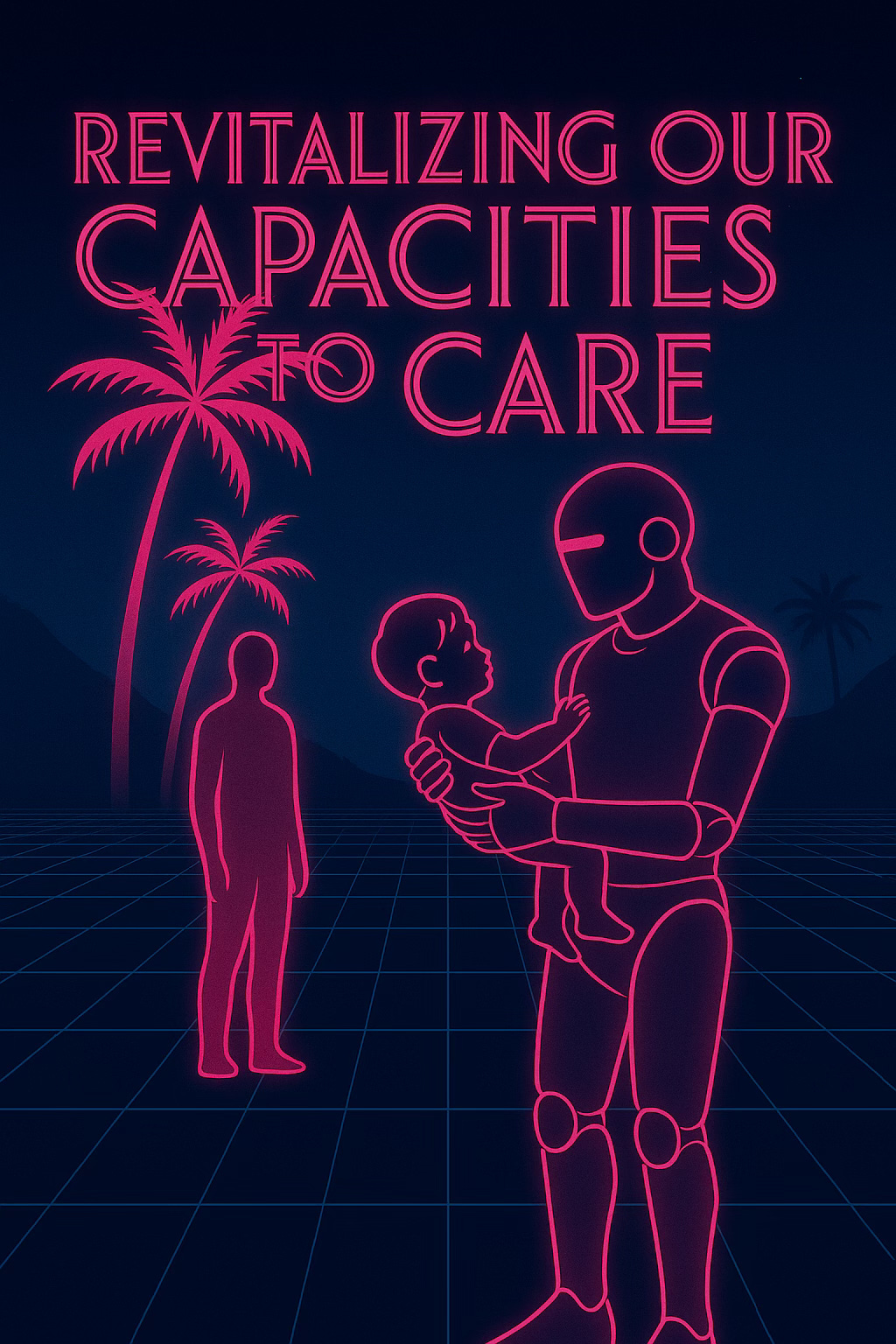
Converging Conversations on Care
The deployment of AI systems into more and more dimension of human life is dizzying. What is at stake? How can we observe and assess the changes that are happening?
One of the core projects in Without Why is to help bring care to the center of our conversations about how to design and live well with AI systems.
My first public contribution to this conversation was my short polemical paper with Professor Peter Denning, “Can Machines Be in Language?” (published last year in Communications of the ACM). Our aim was to sketch various ways in which human language is interwoven with human practices of care and taking-care in common.
It is heartening to notice a rising tide of interest in care and its relation to AI. For example, UC Berkeley’s celebrated Alison Gopnik has emerged as a distinctively powerful voice in this conversation.
Gopnik and her team are putting out a steady stream of research into the social science of care-giving, and she is focused on how this perspective can enrich AI research. For one of many examples, see her short, inspiring piece, “A Very Human Answer to One of AI’s Deepest Dilemmas.”
In addition, Brian Christian, author of the essential book, The Alignment Problem, has also turned his attention to care in his recent paper, “Computational Frameworks for Human Care.”
Next, a brand new pre-print by distinguished group of researchers at the Meaning Alignment Institute, MIT, Oxford, and more has just released a compelling vision in a position paper called “Full-Stack Alignment: Co‑Aligning AI and Institutions with Thick Models of Value.”
The last phrase in this title, “thick models of human value,” is synonymous with how I understand the phenomenon of care. The authors present a framework that resists reducing deeply human phenomena like care into simplistic and distorting metrics.
I also see the recently released Resonant Computing Manifesto, which I signed, as contributing to this emerging consensus: it is time to move beyond dreams of optimization, control, and problem-solving toward a more holistic, care-centered, approach to human flourishing in the age of AI.
Thus, Alex Komoroske, one of the main contributors to the Resonant Computing Manifesto, recently penned a compelling piece called “What Gets Lost in the Optimization” (here, and co-posted to the Cosmos Institute Substack). The Manifesto was also sympathetically covered in Wired magazine last week in an article called, “It’s Time To Save Silicon Valley From Itself.”
Finally, the fact that the Topos Institute in Berkeley has brought me on as an affiliate researcher (“Philosopher in Residence,” my favorite title) for their organization shows their commitment to amplifying and refining our human capacities to care, and to doing so while also taking advantage of the social and ecological good that can be produced with the technological tools of abstraction and formalization. We can’t just leave technology behind. We need to invent ways to create technologies in service of our capacities to care. Topos is on this mission.
(See my text with Topos co-founder, David Spivak, “Notes on Care,” for a hint at a longer publication forthcoming from us.)
One way to summarize the perspective on care that I have been articulating is as follow:
In caring, we distinguish the important from the trivial, tend to what matters, and sustain and evolve our social bonds (including tacit forms of local, embodied knowledge). Caring gives substance and direction to our rationality and autonomy, but it is not a guarantee of moral goodness, so it demands our reflection; nor, however, can our care be fully captured in reflective formalizations and abstractions.
What is a contribution I can make to this emergent, collective project of rekindling a concern with care? To draw together, focus, and further develop the traditions that I embody from my study of phenomenology and my collaborations with the key figures who critiqued the first waves of AI research in the last century: Hubert Dreyfus, Stuart Dreyfus, Fernando Flores, and Terry Winograd.
To this end, I have ended this first year of Without Why with a capstone series:
The Limits of Autonomy: Technology, Nihilism, and Giving a Damn, Part I
The Limits of Optimization: Technology, Nihilism, and Giving a Damn, Part II
The Limits of Care: Technology, Nihilism, and Giving a Damn, Part III
Punk as a Response to Nihilism: Technology, Nihilism, and Giving a Damn, Part IV.
In Part III, I staged a comparison between the views of two of my main mentors and collaborators, Hubert Dreyfus and Fernando Flores, on the topic of commitment, care, and meaning in human life.
The final section of that post sketched out an incipient synthesis of what I learned in working with both Bert and Fernando and in thinking through their views. Since it was buried at the end of a long post, I want to share that sketch again. Here it is. I added some new sub-divisions and section headings.
Some Dynamics of Giving a Damn
Drawing upon my recollection of this debate between Hubert Dreyfus and Fernando Flores, and upon my many years being immersed in conversation with both, I will now offer a rough summary of my current, developing understanding of what the art of giving a damn consists in.
While I take myself to be expressing what I learned from working and collaborating with both Fernando and Bert, I won’t attribute the following structure to either of them (though I will certainly ask Fernando what he thinks).
So, without offering the following as any kind of formal definition or complete account, let me venture a few elements of the fragile capacity to give a damn, the skills to properly receive and enact the givenness of giving damn, the structure of the activity of “taking care.”
Receptivity
Receptivity to the concerns, projects, and relationships that call to you as intrinsically important (without regard for extrinsic reward or instrumental advantage).
Tapping into this receptivity means letting go of the urge to plan, choose, and control everything. It also requires recognizing the limitations of reason and morality.
Reason and morality can only take us so far here: they are what any rational agent should or should not do; but that doesn’t tell us what I personally, here and now, at this moment in history and in my particular lifetime, should care about and devote myself to.
Again, nor can willpower or individual autonomy settle the issue of what we should care about. What we care about calls us as worthwhile. We find ourselves finding it important. What we love and care about is not a matter of free choice, it is what guides and directs our choices. We are solicited, gripped, moved by something or someone beyond us.
Linguistic Articulation
But our receptivity to the importance of what we care about is bound up with how we focus and articulate this importance in language. For example, that’s how it was with me identifying as a punk rocker: the raw, disoriented sense of something’s off didn’t become a commitment or an identity until I was gripped by the linguistic articulations in various punk songs about the condition of the world. Similarly, the founding fathers of the US put forth the truths they took to be “self-evident” in a linguistic articulation that provided foundational for the identity of being an American.
Here I am drawing upon the work of Charles Taylor, for example, his book The Language Animal: The Full Shape of the Human Linguistic Capacity.
Turning Concerns Into Offers and Projects
The path is listening, attuning, articulating, and responding to what beckonsas worthwhile, along with a historical sensibility for the issues and concerns of our times that call out as important, anomalous, and unsettling, thus beckoning our involvement and commitment. On this point, I am again inspired by Disclosing New Worlds (by Charles Spinosa, Fernando Flores, and Hubert Dreyfus), as well as Understanding Computers and Cognition, by Terry Winograd and Fernando Flores.
To find what is important, it is important to look outward at the current concerns worthy of our commitment and involvement, not inward at what we want or like.
As Fernando put it to me once: “Rather than asking what you want out of life, ask what you have to offer the world. Then the adventure of life can really begin.” In the phrase, “what you have to offer the world,” I hear echoes of Dreyfus’s Kierkegaardian notion of what someone feels they have to do with their life.
Courage to Commit
Courage to commit ourselves to a project, concern, or relationship, and the wherewithal to sustain our commitment in word and deed over time, despite the fact that there are no guarantees we selected “the right” one, that we will almost certainly need to revise and evolve our commitments and understanding of ourselves as we go along, and that there are innumerable ways the whole thing might fail, leading us to a possible collapse of our identity and necessity to reinvent ourselves.
Here I am inspired by Dreyfus’s interpretation of Kierkegaard and John Haugeland’s interpretation of Heidegger. Haugeland was one of Dreyfus’s first PhD students.
Belonging
Belonging to a shared “we,” a community, often carrying on an established (but not static) tradition, dedicated to actively connecting with and taking care of the projects and concerns that grip us; ideally, a “we” that is embodied and enacted and irl (“in real life”).
Skills for Taking-Care in Common
Skills for shared action to take care of what is important, such as generously listening to each other’s concerns, conversationally coordinating commitments, aligning interpretations, and attuning to moods so that joint action is imbued with both care and mutual understanding. All “taking care” is taking care together, in conversation, and the navigation of moods.
Here again, I am inspired by Fernando’s work with Terry Winograd, Understanding Computers and Cognition: A New Foundation for Design, as well as Gloria P. Flores’s book, Learning to Learn and the Navigation of Moods. Gloria is Fernando’s daughter and another longtime collaborator of mine. Hubert and Stuart Dreyfus and I wrote a Foreword for her book on moods.
Irreverent and Iconoclastic Questioning
Irreverent and iconoclastic questioning of what is taken for granted as obvious or unquestioned in our society’s common sense, such as our contemporary idolization of optimization, problem-solving and efficiency, or the conviction that the highest goal of life is material success and the comfort of a “white picket fence” (the death of this economic god has been particularly rough on Gen Z according to Scanlon and a big source of its nihilism [see “Gen Z and Financial Nihilism”]), or ontological presuppositions such as the human mind being separate from the body, intelligence being a matter of efficient problem-solving, language being nothing but the processing and transferring of information. (Fernando used to call this the moment of “Ontological detox.”)
Pluralistic Openness
Pluralistic openness to other, sometimes conflicting, traditions and interpretations of what it means to be human and what is worth caring about. Not just openness, but awe and humility in the face of the vast plurality of interpretation of what it means to be human. (For more on this, see my recent post, “The Manifold Varieties of Mattering”)
Radical Hope
Radical hope in face of the disorienting historical ruptures converging in our times (climate crises, the rise of AI, economic chaos, the destabilization of the post-WWII geopolitical order, pandemics, war, genocide), a stand for radical hope: a non-despairing openness to a still unimagined new future whose precise contours we cannot yet foresee; the sense that, no matter what, “we will find a way to go on” amid radical uncertainty and even the possible collapse of our world.
Radical hope is an antidote to fatalism and despair. It is a deliberately cultivated counter-mood against debilitating moods of resignation and resentment that go hand in hand with the nihilism of our times
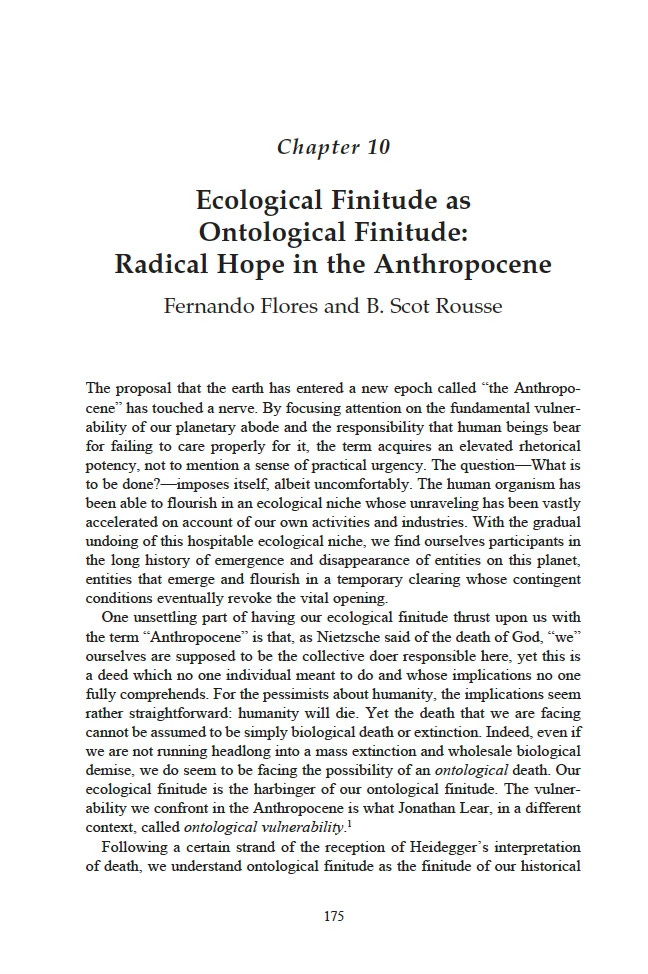
I adopted this notion of “radical hope” here from the excellent book by philosopher and psychoanalyst, Jonathan Lear. Radical Hope: Ethics in the Face of Cultural Devastation. This book inspired previous writing of mine with Fernando Flores: “Ecological Finitude as Ontological Finitude: Radical Hope in the Anthropocene,” which appears as ch.10 in a collection of essays called The Task of Philosophy in the Anthropocene.
What I appreciate here is how care is treated less as a virtue to optimize and more as a capacity that has to be received, practiced, and risked. The way you describe being “gripped” by what matters, prior to choice or justification, feels especially resonant, and it complicates autonomy without dissolving responsibility.
I’m left wondering how these dynamics of care change once AI systems are not just tools but participants in our shared moods and commitments, subtly reshaping what calls to us as worth giving a damn about.