
Note: This essay is a continuation of a series of posts examining how AI impacts human flourishing. See part I of that series, “The Limits of Autonomy”; Part II, “The Limits of Optimization”; Part III (this one), “The Limits of Care,” and the reprise of Part III, “Revitalizing Our Capacities to Care in the Age of AI”; and Part IV, “Punk as a Response to Nihilism.”
Also: Last time I said I would announce my plans for Without Why 2026 in today’s post, but I’m holding off on that until early next week.
Table of Contents
Summary
From Autonomy and Optimization to Brain rot and Nihilism (Review of the Prequels)
A digression on Hitchcock’s Vertigo (illustrating the clash between control and care)
The Receptive Art of Giving a Damn
Hubert Dreyfus and Fernando Flores on Commitment and Care
ALERT: In this third installment in the series, I didn’t hold back or truncate, so this is a long post. I think of it as my capstone post for my first year of Without Why (which officially turns “1” on December 14). The main event of this post begins with section 4. I welcome you to skip right to that part if you are short on time. But please can come back and read the set-up later.
1. Summary
AI arrives inside a cultural mood already shaped by numbness, disorientation, and a compulsive drive to optimize everything. The result is a generation flirting with nihilism, joking about their own “brain rot,” and drifting through a world that no longer calls them into meaningful involvement.
Against this background, this post turns to the deeper question: how do we relearn the fragile art of giving a damn? Drawing on my learning from and collaborations with Hubert Dreyfus and Fernando Flores, I argue that caring isn’t a matter of choosing values or engineering better habits.
Caring is a receptive skill: letting the world grip you, claiming the projects and relations that actually matter, sustaining commitments in word and deed with others over time, and doing this with others in response to the emergent concerns of a shared historical moment.
The heart of the essay lays out what this art requires: receptivity, courage, community, conversational skill, irreverence toward today’s common sense, pluralistic imagination, and a stance of radical hope in the face of possible tragedy. AI won’t save us from nihilism, and neither will autonomy or optimization. Only renewed capacities for care will.
2. From Autonomy and Optimization to Brain rot and Nihilism (Review of the Prequels)
Skip past the review to the main event of the post by clicking here.
Brain Rot and the Limits of Autonomy
As someone said to me recently at a party: “Isn’t it wild to be alive in the timeline when AI gets invented?!” It is! Wild and weird. And demanding of philosophical reflection. The basic capacities of being human are being remixed and reconfigured right before our very eyes.
AI opens up vast new possibilities for creativity, while also being spectacularly corrosive to human wellbeing and autonomy.
Many today worry about a growing trend, presumably more pronounced among young people, to “offload” their freedom of choice to AI, delegating to chatbots everyday decisions about what to say, wear, eat, and think.
But framing such trends as a threat to individual autonomy obscures the deeper context. Who cares about making such choices when life itself just isn’t making sense? Autonomy only matters in the context of a meaningful life where our everyday choices have weight. The sense that our choices don’t matter and that life doesn’t make sense is at the core of the nihilistic mood spreading among young people today.
As I wrote in the previous installment, the mood of nihilism, so strikingly articulated by Gen Z voices such as Kyla Scanlon and Wendy Syfret, involves a diminished feeling of involvement in the world; an impression of being a baffled spectator to a way of life that doesn’t make sense; a queasy intuition that there is ultimately no point to life, nothing worth doing or committing oneself to in the world today.
In the chilling words of Kyla Scanlon:
The constant scrolling tells us that nothing is worth remembering, nothing is worth reflection, nothing is worth production because the act of consumption is simpler.
If you just keep scrolling, maybe that weird disjointed feeling will finally go away.
(See Kyla’s Newsletter, “Gen Z and Financial Nihilism,” boldface mine.)
In this light, the offloading of decisions onto AI is less a rejection of autonomy than a symptom of being left cold by the world; a sense of not feeling summoned by the world, a sense that we live in a world that offers no meaningful possibilities to choose from, but plenty pointless ones.
A glimpse at the internet culture of young people reveals an underlying mood of whimsical cynicism, a cold, detached revelry in the superficial; a mocking, ironic embrace of the pointlessness of life.
Young people laugh and cringe about their addiction to “brain rot”: idiotic, meaningless videos and images circulating on the internet. What are kids doing with all those hours on TikTok? Compulsively consuming content that renders one willingly stupefied and stupid.
Per Wikipedia:
The term brain rot was Oxford Word of the Year in 2024, and refers to the deteriorating effect on one’s mental state when overconsuming “trivial or unchallenging content” online. It can also refer to the content itself.
Just yesterday, my 12-year-old niece introduced me to a viral genre of imbecilic AI-generated music called “Italian brainrot.”
Again Wikipedia:
Italian brainrot is characterized by absurd images or videos created by generative artificial intelligence. It typically features hybrids of animals with everyday objects, food, and weapons.[4] They are given Italianized names or use stereotypical cultural markers and are accompanied by AI-generated audio of an Italian man’s narration, which is often nonsensical.[5] The names of these characters often have Italian suffixes, such as -ini or -ello.[6] These characters combine elements of surrealism, visual anxiety (uncanny valley) and internet irony, reflecting the post-ironic humor of Generation Z.[3]
We have here, in short, a laughing, ironic embrace of the deluge of AI-slop taking over not only the internet but also our very minds. Italian brainrot is an art form that distinctively manifests the technological nihilism of our times.

(I have to say, some of the songs on the Italian brainrot playlist really are ridiculously catchy. My niece tells me that her peers have these songs deeply embedded in their psyches, and how they like to sing the meaningless and absurd lyrics aloud together.)
My 15-year old nephew told me about another current brainrot trend du jour: an obsession with a fake video game called “Bird Game 3.” Don’t ask me to try to explain it to you. There is no point. This short YouTube clip explains what it is, but no one can explain the allure of the trend, because there just is no deep meaning to it. People engage with the trend precisely because it is pointless, stupid, fake, and meaningless.
A recent, flabbergasted New York Times article tried to explain to us old folks another pointless and pervasive trend among the youth: the urge to blurt out the numbers “6-7.” The subtitle of the NYT article is telling:
“Everyone wants to understand the generation below them. Can young people rebuff those efforts by being completely absurd?”
Per the kids quoted in the article, the point of the trend is its pointlessness. It is, it seems, just a pure vocalization of brain rot. There is nothing to understand: “‘There’s not really a meaning behind 6-7’, explained Ashlyn Sumpter, 10, who lives in Indiana.”
The Italian brain rot character, Ballerina Cappuccina, gets a nod in the “6-7” article too, appearing in the comments of an exasperated and disillusioned 22-year old.
Kristen Choi, 22, was at a loss when her well-meaning father asked her to explain the origin of Ballerina Cappuccina, the A.I.-generated dancer. “I don’t think my dad would understand, even if I gave him a flow chart or, God forbid, a slide deck,” she said.
She sees these reality-defying characters as a way of coping with coming of age in a world that is less straightforward than she and her friends had hoped, as many of them struggle to find jobs and think of long-term goals like homeownership as elusive.
Revelry in brain rot is a response to a world that doesn't make sense, a world that refuses to live up to our expectations.
Indeed, the sentiment here looks like a 21st-century mutation of the “profound superficiality” that Nietzsche attributed to the Homeric Greeks. For Nietzsche, the Homeric Greeks had an insight into the fact that there was no deep meaning or singular ultimate explanation for human life. In response to this insight, the cultivated a joyful superficiality and love of appearances:
Oh, those Greeks! They knew how to live. What is required for that is to stop courageously at the surface, the fold, the skin, to adore appearances, to believe in forms, tones, words, in the whole Olympus of appearances. Those Greeks were superficial—out of profundity.1

Brainrotting is an enactment of the nihilism of our times. Nihilism is the atrophy of our capacity to care. Autonomy by itself is not the medicine we need to respond. We can’t just freely choose our so-called “values” or what to care about.
When things, people, projects, and relationships are meaningful and worthy of our care, they get to us. Things matter to us. We need to learn to appropriate and preserve this moment receptivity, to properly receive and enact the givenness of giving damn.
Too much urge to control and choose is corrosive to care.
(This is one of the many places where my narrative here approaches but diverges from the amusingly titled book The Subtle Art of Not Giving a F*ck, by Mark Manson. This work has much in common with Wendy Syfret’s The Sunny Nihilist in, e.g., recommending a leveling-down embrace of mediocrity, but goes further than her in adopting a shallow existentialist voluntarism in the injunction to always explicitly choose one’s values and what matters. Despite Manon’s sensitive embrace of death and finitude, his obsession with choice and control gives the game away back to the nihilism he is trying to remedy).
What we need is to find a way to revitalize our capacities to care. Giving a damn, the enactment of care, is a receptive art we need to relearn. It has a certain structure. (I say more about this concretely in sections 4 and 5 below)
When introducing the notion of care, I often quote the nurse Patricia Benner:
“Caring as it is used in this book means that persons, events, projects, and things matter to people. Caring is essential if the person is to live in a differentiated world where some things really matter, while others are less important or not important at all.
‘Caring’ as a word for being connected and having things matter works well because it fuses thought, feeling, and action-knowing and being.
And the term caring is used appropriately to describe a wide range of involvements, from romantic love to parental love to friendship, from caring for one’s garden to caring about one’s work to caring for and about one’s patients ...”2
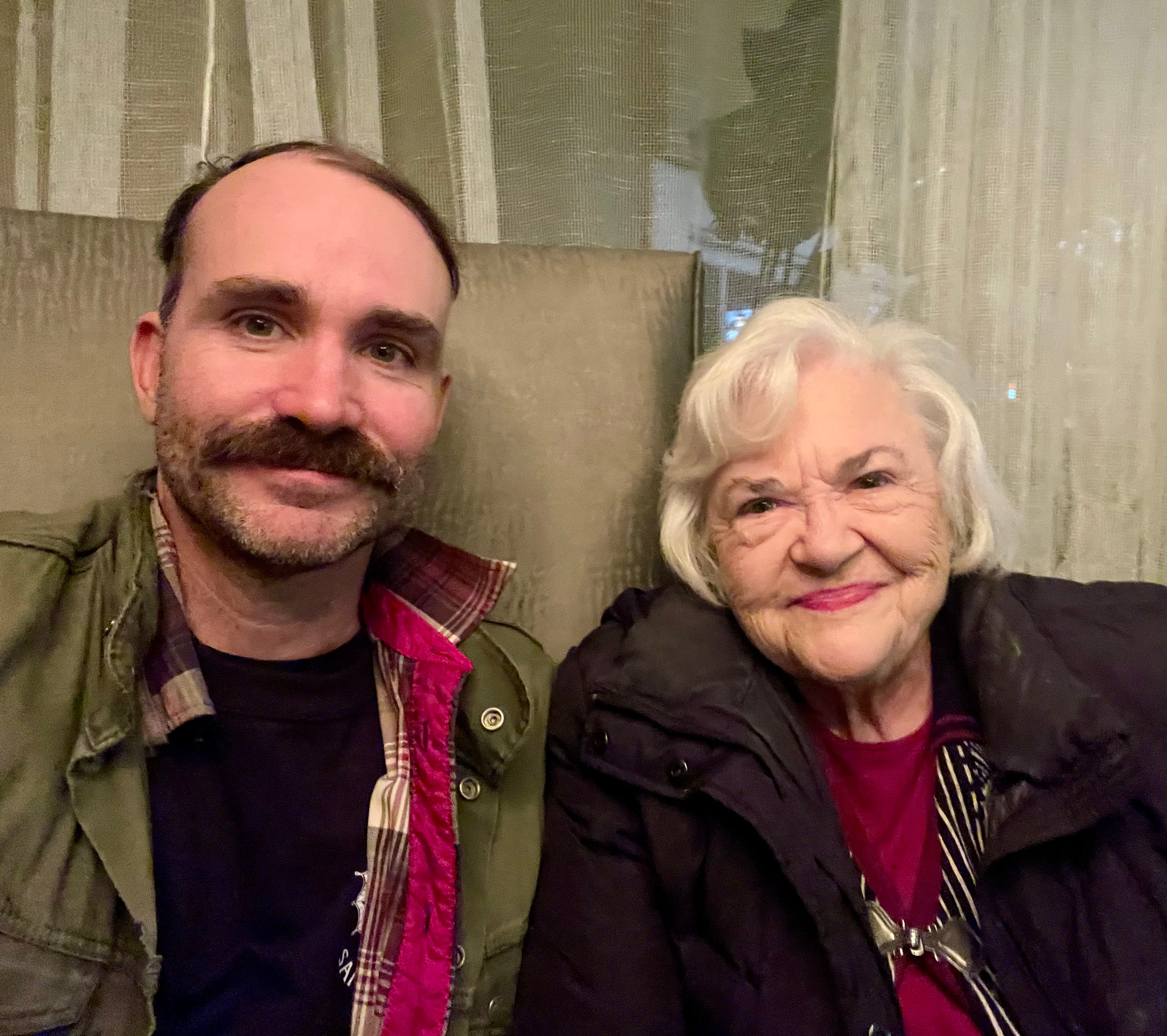
(I first met Patricia Benner in early 2013 when she attended the class on Merleau-Ponty’s Phenomenology of Perception that I was teaching with Hubert Dreyfus at UC Berkeley. Here we are at a conference together in 2024.)
The Limits of Optimization
In the second installment of the series, “The Limits of Optimization,” I focused on the wider technological climate shaping our lives. Contemporary AI arrives in a world already saturated with an optimization ethos: the sense that every aspect of life should be streamlined, quantified, and efficiently checked off a to-do list.
This culture of compulsive optimization, training us to approach life as an unending escalator of problems to solve, leaves little room for the slower, riskier work of caring about something for its own sake, rather than because it is a means to some further end or an avenue to additional options.
The techno-solutionism popular in Silicon Valley, the dream to reduce all human problems into engineering problems with optimal solutions, is part and parcel of this very historical condition.
When life collapses into a set of solvable tasks, then of course we reach for tools that promise better solutions. But this is precisely the danger. Techno-solutionism doesn’t just misapprehend the human condition; it deepens our alienation from the kinds of projects and relationships that can’t be optimized, predicted, or automated, i.e., the kind of projects and relationships that matter and that are worthy of our care.
As I have said in my work on care with David Spivak (here and here): Caring is tending to what matters (this phrase is David’s). And we can’t properly tend to what matters while trying to optimize and control it.
2. Illustration: The Clash Between Control and Care in Hitchcock’s Vertigo
One of my favorite depictions of this dynamic is Alfred Hitchcock’s Vertigo, which presents a cinematic reduction ad absurdum of a certain over-controlling picture of romantic love.
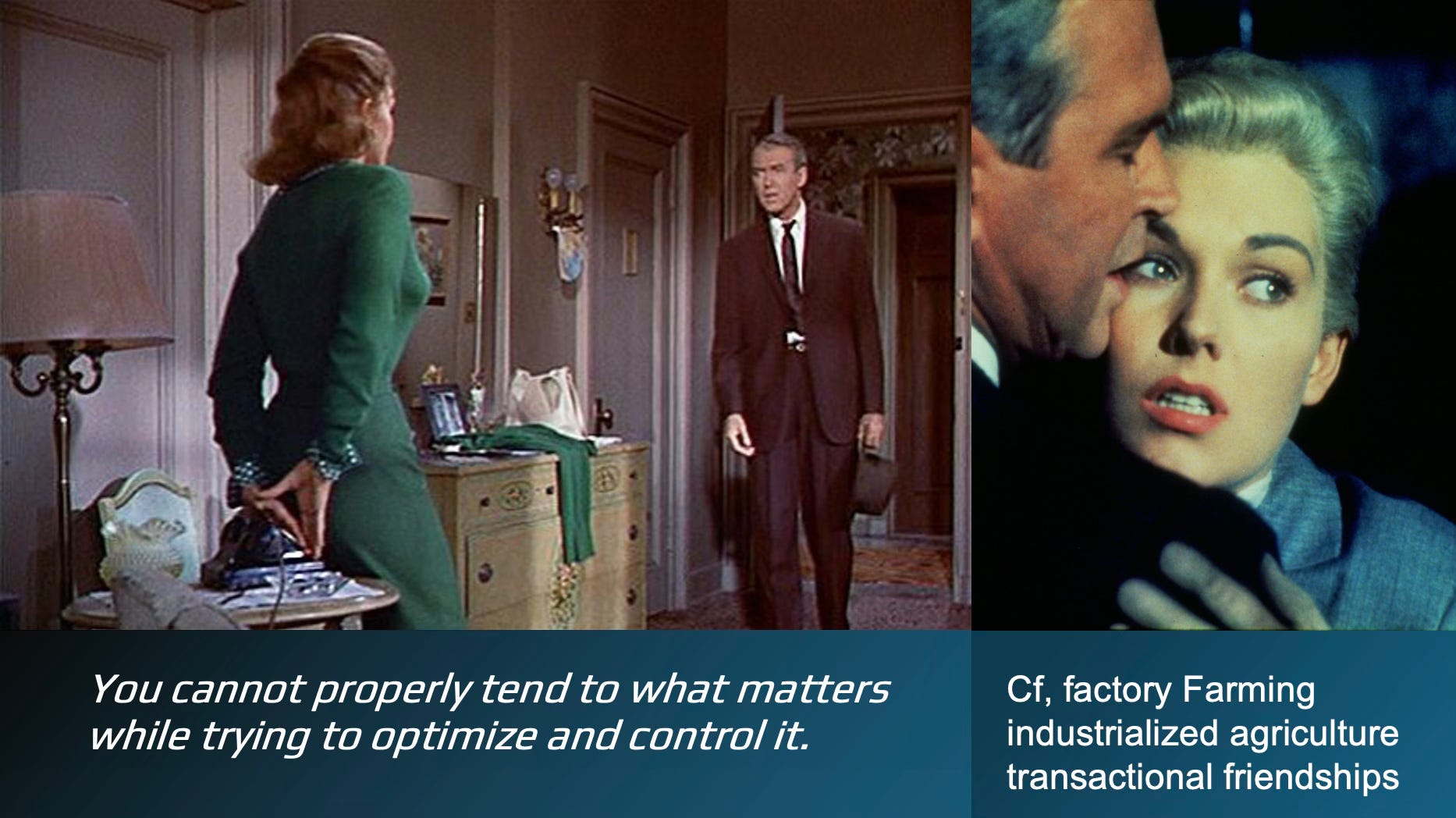
Scottie, the James Stewart character, becomes fixated not on loving Judy (Kim Novak), but on turning her into a more precise replica of a woman he once knew. What begins as longing mutates into a grotesque project of control.
He escorts her into boutiques, dictates her clothing, hair, and makeup, and insists on exact matches to the lost ideal. Every gesture becomes part of a workflow: a step in a process of narrowing her into compliance with his preferences and plans. Scottie treats intimacy as something that can be engineered by iterating toward an optimal state.
The very orientation of control ejects one from the relational field in which care takes place. Love collapses into procedure. Attention collapses into manipulation. A connection becomes an engineering problem to solve, and in the solving, the connection dissolves.
Whenever we approach our relationships, commitments, or identities with such a logic of improvement and optimization, we risk turning them into a Scottie’s Judy, something we force into the shape of our calculations, instead of something we meet, answer to, and grow with. Meaningful care requires involvement, risk, responsiveness. Optimization brings detachment, monitoring, and instrumental control.
3. The Receptive Art of Giving a Damn
To be drawn into connection with what we care about is to find a path back to human flourishing, back through the nihilistic depletion wrought upon us by the pressures of compulsive optimization, continuous choosing, and the seductions of the infinite scroll.
And yet this receptive capacity, this strange human susceptibility to being moved, is, again, by nature vulnerable. Our capacity to care itself can be dulled, numbed, distracted, fragmented. It can be crowded out by the incessant demand to improve, choose, optimize, and control.
As I put it last time, foreshadowing what we will discuss in the rest of today’s post:
“Raising a child, sustaining a loving relationship, articulating new social concerns that demand your attention, healing conflict in your cherished friendships, cultivating community with your neighbors, and identifying the traditions worthy of your dedication, for example, are not problems with definite optimal solutions, but ongoing projects to inhabit and navigate in uncertainty, conversation, and commitment [to paraphrase relationship expert Esther Perel].
Living a life of care demands a revitalization of our capacity to care, the receptive art of giving a damn.
The receptivity to be claimed by concerns that call out as important, and the courage to sustain commitments despite fragility and uncertainty.
The skills for taking care together, in conversation, as part of concrete communities dedicated to what matters.
Iconoclastic questioning of optimization itself as the measure of life, and other taken-for-granted elements of today’s common sense.
And radical hope: that non-despairing openness to futures we cannot yet clearly imagine.”
I turn to these details now.
Hubert Dreyfus on Commitment and Care
The definition of care that I provided from Patricia Benner above shows the influence that Hubert Dreyfus, our mutual teacher, had upon her approach to these issues. In a legendary course Bert taught for more than 40 years at UC Berkeley, Existentialism in Literature and Film, he movingly drove home the role that commitment played in enabling people to live meaningful lives.
His hero in this story, was the 19th-century Danish philosopher and theologian, Søren Kierkegaard. As I hinted, the key notion in Bert’s interpretation of Kierkegaard is what Bert called “unconditional commitment.”3 This is the kind of commitment that provides the very condition for your identity and involvement in the world.
Some commitments we make only given certain conditions:
I am committed to paying rent only on the condition that my office provides a suitable place to study and write.
I am committed to playing in my current band only upon the conditions that we have good chemistry in our song-writing, that the guitar riffs elicit from me captivating and enjoyable drum beats, and that each member put in the appropriate amount of mutual effort to make this particular combination of talents and passions both rewarding and awesome.
But unconditional commitments aren’t like that. Dreyfus focuses on Kierkegaard’s example of romantic, chivalric love to make his case.
When we truly fall in love, we are not doing this for (or conditional upon) any particular reason or reward. Our expression of falling in love captures this phenomenon nicely.
Falling in love is an event we find ourselves willingly swept up into, a relation that defines us and which, subsequently, we are unable to imagine ourselves without it. The relation itself becomes one of the conditions of our very identity, making us who we are, structuring our involvement in the world, guiding how we prioritize our time and activities.
Because there are no grounds, rational justifications, or other conditions to explain why a person takes on such a commitment or falls in love, Kierkegaard refers to it as a leap.
For a phenomenological account of these reconfigurations in identity, see my paper, “Existential Selfhood in Merleau-Ponty’s Phenomenology of Perception” [pdf here], which appeared in 2023 in Continental Philosophy Review.
Kierkegaard also sometimes used the phrase “an infinite commitment to something finite” to capture what he is after here.
As Dreyfus emphasizes, Kierkegaard means to generalize from the case of romantic love, although the transformative agapé love that the apostles had for Jesus is another paradigm case of what Kierkegaard thought of as an infinite commitment to something finite.4
Dreyfus mines a lot from what otherwise might look like a minor footnote in Fear and Trembling. In the footnote, Kierkegaard qualifies his mention of chivalric love by saying: “any other interest whatever in which an individual concentrates the whole of life’s reality” would reveal the commitment-phenomenon he is exploring.5
In a dazzling, brief, and provocative essay on Kierkegaard’s conception of the self, Dreyfus summarizes his conception of the unconditional commitment:
“Thanks to [the unconditional commitment], [a person] knows who he is and what is relevant and important in his world.
Any such unconditional commitment to some specific individual, cause, or vocation whereby a person gets an identity and a sense of reality would do to make the point Kierkegaard is trying to make.
In such a case the person becomes an individual defined by his or her relation to the object of his or her unconditional commitment. The lad is the lover of the princess, Martin Luther King Jr. is the one who will bring justice to the American blacks, Steve Jobs identifies himself with Apple Computers, etc.”6
Commenting on Kierkegaard’s notion of an infinite commitment to something finite, Dreyfus adds:
“Of course, the object of my infinite passion is something finite . . . But any such finite being is vulnerable, and yet the meaning of my life depends on it. This makes a defining commitment very risky.”7
Think about it: everything finite that we devote ourselves to, every relationship, project, ideal, can fail in any number of ways. It might not work out; your project or relationship might fail, your beloved might change, leave you or die; you might change; you might loose your ability to pursue your passion (eg, a musician going deaf, a painter going blind), and so on and on…
And if we define our identities and the contours of our world by what we love and fundamentally care about, then loving and caring puts our very identity at risk. Loving and caring makes us vulnerable to the collapse of our world.
That riskiness, the fact that we put our selves and world at stake in the commitment, is what makes such involvements meaningful, rather than merely pleasant, consoling, or thrilling.
To live in light of such risky, vulnerable commitment is to live in devotion to and service of what you love, to define yourself and your world through this love, both in spite and because of the fragility of this whole endeavor.
The riskiness of whole endeavor makes it kind of crazy or, in Kierkegaard’s words, absurd. Hence one of the most memorable passages in Kierkegaard’s Fear and Trembling:
Every moment to see the sword hanging over the loved one’s head and yet find, not repose in the pain of resignation, but joy on the strength of the absurd—that is wonderful.8
Dreyfus’s lectures on Kierkegaard from his Existentialism in Literature and Film class are available on YouTube here. This version of them linked here is deeply flawed, however, because it decontextualizes the lectures from the overall arc of the course. The arc moves from Kierkegaard, to Nietzsche, to Dostoyevsky, and includes essential discussions of movies such as Hiroshima, Mon Amour, The Third Man, and Breathless. I am beginning to work with Bert’s wife, Genevieve, to create a better audio archive of Bert’s lectures that will embed them in their proper context, including with the relevant syllabi and plentiful handouts that Bert always shared in his courses.
“Unconditional Commitment? Where Can I Get One?”
Dreyfus’s presentation of Kierkegaard’s notion of unconditional commitment was seductive. He brought Kierkegaard’s thought to life through his vivid readings of the vicissitudes of romantic love in classic movies such as Hiroshima, Mon Amour and The Third Man.
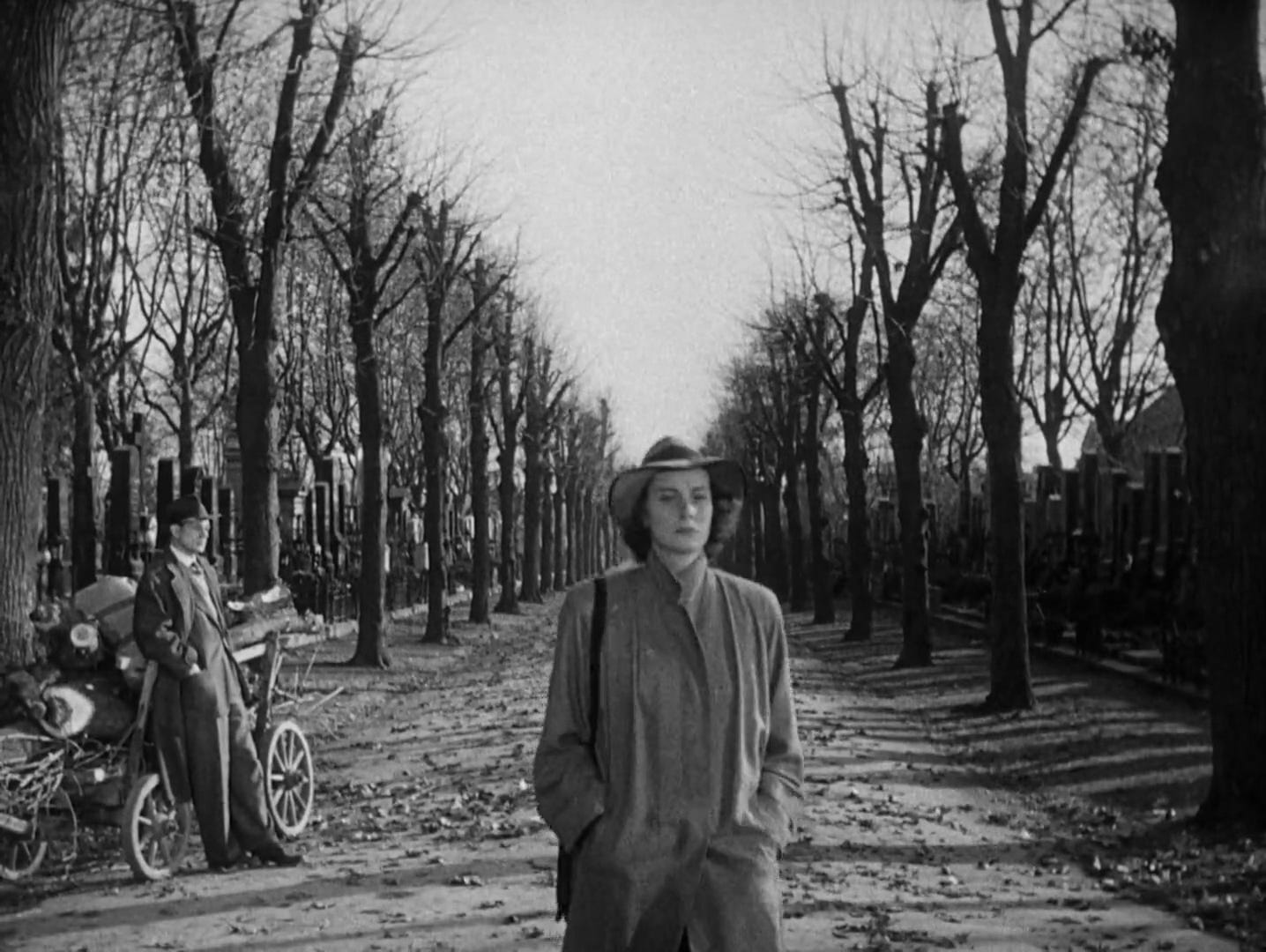
Dreyfus often used himself and his unconditional commitment to being a teacher as one of his main examples. Given what an inspiring teacher he was, and how palpably committed he was to the adventure of thinking, and the way he made this into an experience of a shared adventure of discovery upon which the whole class was embarked together, it is no wonder that students left his lectures on Kierkegaard intensely interested in finding out how to live a life of unconditional commitment.
I was the teaching assistant for almost every class Bert taught in the last seven years of his life, including several times for Existentialism in Literature and film. There was a certain semester when Bert’s lectures on Kierkegaard and commitment made an extra-intense impression on the students.
He had recently taken a fall while walking down a steep hill near his house in the Berkeley hills. Given his absolute devotion to teaching, he didn’t cancel class. Instead, he showed up to lecture wearing one of his characteristic purple shirts, sporting two black eyes, and rosy red road rash all over his face.
After one of the lectures on Kierkegaard during that semester, a stirred up undergraduate student came up to me. “B,” he said earnestly, “an unconditional commitment sounds awesome. Where can I get one?”
The question reveals how deeply the technological ethos of optimization control had permeated the student’s way of being, prompting him to completely misunderstand the phenomenon Dreyfus and Kierkegaard had in view.
As mentioned, to be gripped by this technological ethos is to relate to life and the world as a series of problems to solve and options to be optimized. Without thinking about it or noticing, when in the grip of this ethos of optimization, we relate to everything in life as options we can choose off of a menu or order from Amazon.
Unconditional commitments, rather than being intrinsically valuable relationships we are called to care about for their own sake, get dragged back into an instrumental, means-ends logic of control; they get reduced to a means to make us “happy.”
In the words of Heidegger scholar, Mark Wrathall, this attitude exemplifies the “optionalization of everything” characteristic of our technological age. As Wrathall puts it in the new entry (highly recommended!) he wrote on Martin Heidegger for the Stanford Encyclopedia of Philosophy:
Choosing an option involves no enduring genuine commitment to what is chosen. After the choice of one option, we are free to revisit the choice later and substitute another option for the one first selected. But the danger implicit in the optionalization of everything is that everything is reduced to having merely instrumental significance.9
Interestingly, Fernando Flores—whom I met through Hubert Dreyfus and who also studied with Bert for his PhD, although a generation before me—reminded me of the striking similarity between my student’s question about where to “get” an unconditional commitment and a notorious comment from one of Martin Heidegger’s students. Upon hearing Heidegger’s lectures on the importance of “self-ownership” and “resoluteness” in human life, a student reportedly quipped:
“I am resolved, only toward what I don’t know.”10
Although Heidegger’s student doesn’t traffic in precisely the same confusion that my and Dreyfus’s student did (namely, assuming that commitments are susceptible to being chosen like options on a menu), the sense of a nihilistic lack of direction expressed by both is notable.
The thing is, we find no substantive reply to the lost student in Dreyfus’s lectures, or in his writings on Kierkegaard and early Heidegger, whose conceptions of self-ownership and resoluteness he reads through Kierkegaard.
Well, part of the problem is that the question is malformed, being posed from a framework that reduces commitments to options. But even getting past this “optionalization” framing, when Dreyfus expressed a position on the question of how one enters into, or finds, an unconditional commitment there was not much he was willing to say. In his lectures on Kierkegaard and Heidegger, he would often deploy the language of being grabbed by something or someone: “Something just grabs you.”
As Dreyfus put it in his lectures on Division II of Being and Time, a commitment like this is “anything that causes [i.e., gives rise to] your world of significance, which grabs you and tells you what’s important to do, and what’s not important to do, and what you’ve got to do now, and what you don’t have to worry about because it’s trivial.”11
These comments reveal for me how Dreyfus was a consummate philosopher of receptivity. He constantly strove to counteract the distorting over-emphasis that the western philosophical tradition has placed on individual reflective agency, autonomy, control, and planning.
For him, the emphasis was all about the experience of receiving a singular call.
(Note: I believe that Dreyfus’s lectures and writings on Herman Melville’s ontological pluralism and polytheism in Moby Dick open up a substantive response to the issues at stake here surrounding how one “finds” the commitments around which they structure their lives. This dimension of his thinking actually brings him into close proximity with the concerns motivating Fernando Flores’s critique of his Kierkegaardian position, which I review just below. Bert was aware of this fundamental tension in his overall thinking. He told me: “When I’m teaching Kierkegaard, I’m a total monotheist, but when I’m teaching Melville, I’m a total polytheist.” This post is already much too long to explore these subtleties and connections here).
Fernando Flores on Hubert Dreyfus on “Unconditional Commitment”
In 2015, I was in the second year of a 10-year stint of running educational programs with Fernando Flores in his company, Pluralistic Networks. That year, two years before the death of Hubert Dreyfus, we hosted an event for our students where Fernando and Bert engaged in a conversation and debate about Dreyfus’s Kierkegaard and unconditional commitment.
One of the most productive moments of the conversation is when they explored the question of where “unconditional commitments” come from in an individual’s life. Fernando cleverly showed that the trajectory of Bert’s own life, in particular how he found himself embroiled in philosophical controversies around the first wave of AI research, revealed considerably more than his claim that unconditional commitments simply grab you, if you are lucky.
One of Fernando’s key moves in the conversation is to emphasize the role of historical contingencies. Well, not historical contingencies per se, but an individual’s readiness to attune and respond to the particularities of their historical moment and this particular moment of their life; a readiness to rise to the occasion of the concerns and projects that the drift of life history hold up to them as significant and demanding of a response.
For Fernando, to be ready to be grabbed by an unconditional commitment (in Dreyfus’s sense), requires cultivating an openness to existential adventure and the sensibilities of a historical navigator.
Fernando’s point is that an unconditional commitment never just descends fully formed from the heavens or the head of Zeus. It arrives through the weird contingencies of a life and a world already underway.
Such was the way that Dreyfus found himself in the middle of the earliest debates about the possibility of artificial intelligence in the 1960s at MIT and then, at the RAND corporation, through the contingent connection of his brother, Stuart, who worked there.
(Someone who worked at RAND with Stuart had a brother who wrote to advise RAND against investing in the new field of computer intelligence until someone had studied the work of the phenomenologist, Maurice Merleau-Ponty, a philosopher whose work Bert studied closely. Stuart referred his brother, and suddenly, “two months later [Bert] was at RAND, hired as a consultant to evaluate their pioneering work in what was then called Cognitive Simulation.”12
Bert didn’t set out with a rational life plan to be the philosophical thorn in the side of MIT’s AI establishment, or the author of the first philosophical critiques of aritficial intelligence with his 1965 RAND report, “Alchemy and Artificial Intelligence,” and then 1972 book What Computers Can’t Do.
But the contingencies of his life and historical moment, prepared the way, and then and his courage to take on the powerful AI establishment at MIT (where he was an untenured junior professor) and his readiness to rise to the adventure, enabled him to be so “grabbed.”
(Bert was always deeply suspicious of the very notion of a “rational life plan,” even though this notion was widely accepted at face value by most philosophers of his day, and deployed in one of the most influential philosophy books of the 20th century, A Theory of Justice, by John Rawls).
Fernando draws out how unconditional commitments are historical through and through. They emerge from contingencies, accidents that become necessities, in a Kierkegaardian phrase that Dreyfus liked.
Bert’s being denied tenure at MIT after his critical work on AI (a decision ultimately overturned by the university president), his simultaneously receiving an offer of tenure at Berkeley, his teaching of a whole lineage of students that formed around him over the course of almost 50 years at Berkeley: for Fernando, this is how a commitment shows itself historically, setting up a further context of contingencies and relationships in which other people, and subsequent generations, can become receptive to their own callings.
Fernando is reminding Bert that the leap into an unconditional commitment is never just a leap. It’s a response to a world, and specific historical conditions, that have already claimed you, and your commitment only becomes unconditional because it’s entangled with the histories and people who make your life what it is.
Finding something worthy of commitment, and living a life in dedicated pursuit of this commitment, doesn’t take the form of sitting back and reflecting on what you want, what you value, or what would make you happy.
Rather than looking inward, Fernando emphasizes the importance of looking outward at the issues and concerns currently worth caring about in your world, given the contingencies and particularities of your life and historical moment.
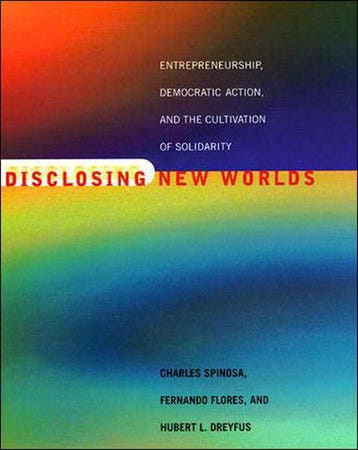
In the conversation, Bert gleefully accepted Fernando’s narration of his life and the corresponding point about the historical nature of unconditional commitments. And the points Fernando was making about history would not have come as any surprise to Bert, since they are also implied by the conception of “making history” worked -out in the book they co-authored together with Charles Spinosa: Disclosing New Worlds: Entrepreneurship, Democratic Action, and the Cultivation of Solidarity (1996);
There were two other big, related issues on which Fernando pressed Bert in this conversation. I will summarize them briefly before ending with a kind of programmatic summary.
First, Fernando stressed the role that social coordination and cooperation play in enabling a person to pursue their calling. Bert often described commitment as if they were an essentially solitary affair: a lone figure seized by an infinite passion, making the leap regardless of risk, answering only to the call that grips them.
Of course, in this Bert is following Kierkegaard himself, who was fascinated by the lonely anguish Abraham must have felt in experiencing God’s command to sacrifice his only son, Isaac.
Fernando thinks that this picture underplays the social texture of how commitments actually take hold and become effective in the world. Pretty much all meaningful human commitments require, in their execution, coordinating with, confronting, and engaging with other people. It requires building alliances, overcoming adversaries, and
Second, Fernando worries that Bert’s picture of commitment is overly rigid. Bert (in what he referred to as his tendency toward a kind of “monotheism”) tends to frame unconditional commitment as a fixed stance: once it grips you, you don’t let it go.
Bert used the character of Anna in The Third Man (pictured in the image above) to exemplify this. Anna remained steadfast in her love for and commitment to Harry Lime, even after learning of the horrible crimes he was committing in diluting penicillin to sell on the black market, resulting in the death of innocent children. Anna thus reprimands the moralistic Holly Martins: “A person doesn’t change just because you find out more” (i.e., because you find out about more about their misdeeds).
In Fernando’s telling, real commitment breathes with contingency. It’s porous to the unfolding of events, open to transfiguration, shaped by the histories and happenings that keep sweeping through life. For Fernando, commitments are not monuments; they’re trajectories. Mandela’s transformation in prison, Martin Luther King, Jr.’s realization that local strikes and negotiations wouldn’t be enough but that federal law had to shift, these weren’t betrayals of their commitments, they’re the living enactment of them. The commitment reconfigures and deepens as history discloses what the situation actually requires.
Revitalizing Our Capacities to Care
Drawing on my recollection of this debate between Hubert Dreyfus and Fernando Flores, and upon my many years being immersed in conversation with both, I will now offer a rough summary of my current, developing understanding of what the art of giving a damn consists in.
While I take myself to be expressing what I learned from working and collaborating with both Fernando and Bert, I won’t attribute the following structure to either of them (though I will certainly ask Fernando what he thinks).
So, without offering the following as any kind of formal definition or complete account, let me venture a few elements of the fragile capacity to give a damn, the skills to properly receive and enact the givenness of giving damn, the structure of the activity of “taking care.”
Receptivity to the concerns, projects, and relationships that call to you as intrinsically important (without regard for extrinsic reward or instrumental advantage).
Tapping into this receptivity means letting go of the urge to plan, choose, and control everything. It also requires recognizing the limitations of reason and morality.
Reason and morality can only take us so far here: they are what any rational agent should or should not do; but that doesn’t tell us what I personally, here and now, at this moment in history and in my particular lifetime, should care about and devote myself to.
Again, nor can willpower or individual autonomy settle the issue of what we should care about. What we care about calls us as worthwhile. We find ourselves finding it important. What we love and care about is not a matter of free choice, it is what guides and directs our choices. We are solicited, gripped, moved by something or someone beyond us.
But our receptivity to the importance of what we care about is bound up with how we focus and articulate this importance in language. For example, that’s how it was with me identifying as punk: the raw, disoriented sense of something’s off didn’t become a commitment or an identity until I was gripped by the linguistic articulations in various punk songs about the condition of the world. Similarly, the founding fathers of the US put forth the truths they took to be “self-evident” in a linguistic articulation that provided foundational for the identity of being an American.
The path is listening, attuning, articulating, and responding to what beckons as worthwhile, along with a historical sensibility for the issues and concerns of our times that call out as important, anomalous, and unsettling, beckoning our involvement and commitment. On this point, I am again inspired by Disclosing New Worlds.
As Fernando put it to me once: “Rather than asking what you want out of life, ask what you have to offer the world. Then the adventure of life can really begin.” In the phrase, “what you have to offer the world,” I hear echoes of Dreyfus’s Kierkegaardian notion of what someone feels they have to do with their life.
Courage to commit ourselves to a project, concern, or relationship, and sustaining our commitment in word and deed over time, despite the fact that there are no guarantees we selected “the right” one, that we will almost certainly need to revise and evolve our commitments and understanding of ourselves as we go along, and that there are innumerable ways the whole thing might fail, leading us to a possible collapse of our identity and necessity to reinvent ourselves.
Here I am inspired by Dreyfus’s interpretation of Kierkegaard and John Haugeland’s interpretation of Heidegger. Haugeland was one of Dreyfus’s first PhD students.
Belonging to a shared “we,” a community, often in an established (but not static) tradition, dedicated to actively connecting with and taking care of the projects and concerns that grip us; ideally, a “we” that is embodied and irl (“in real life”).
Skills for shared action to take care of what is important, such as generously listening to each other’s concerns, conversationally coordinating commitments, aligning interpretations, and attuning to moods so that joint action is imbued with both care and mutual understanding. All “taking care” is taking care together, in conversation, and the navigation of moods.
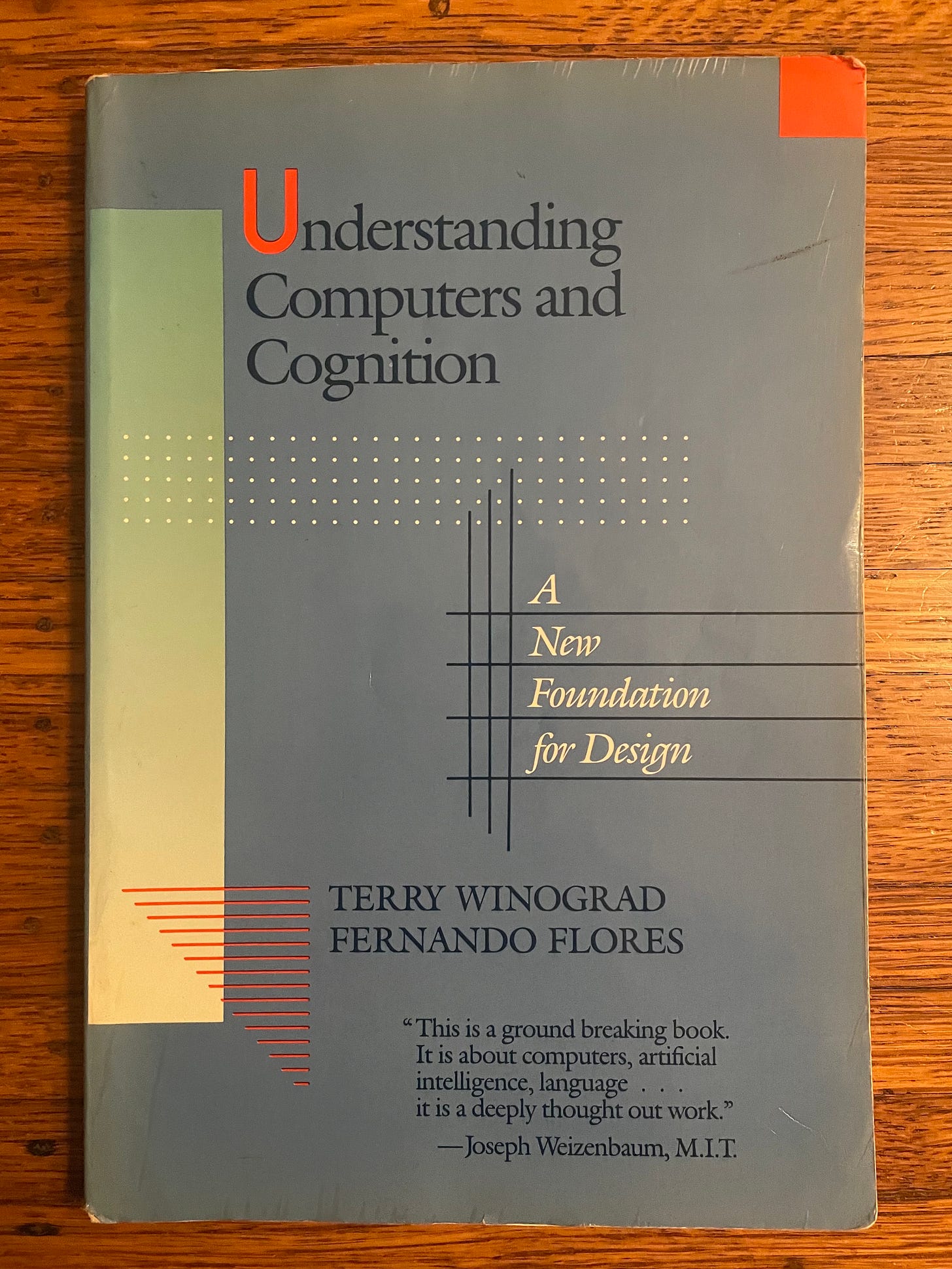
Here again, I am inspired by Fernando’s work with Terry Winograd, Understanding Computers and Cognition: A New Foundation for Design, as well as Gloria P. Flores’s book, Learning to Learn and the Navigation of Moods. Gloria is Fernando’s daughter. I co-wrote with Hubert and Stuart Dreyfus a Foreword for her book on moods.
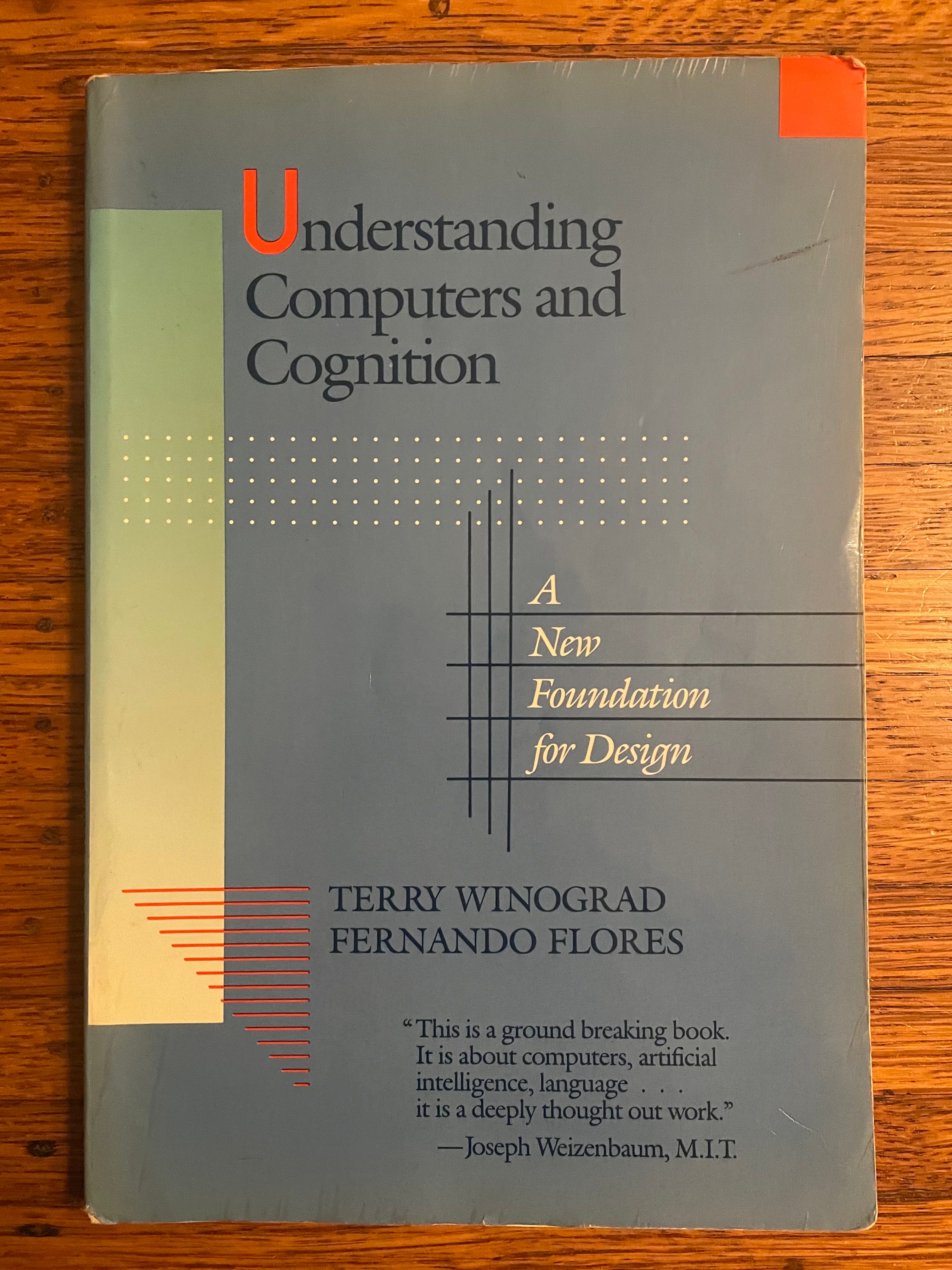
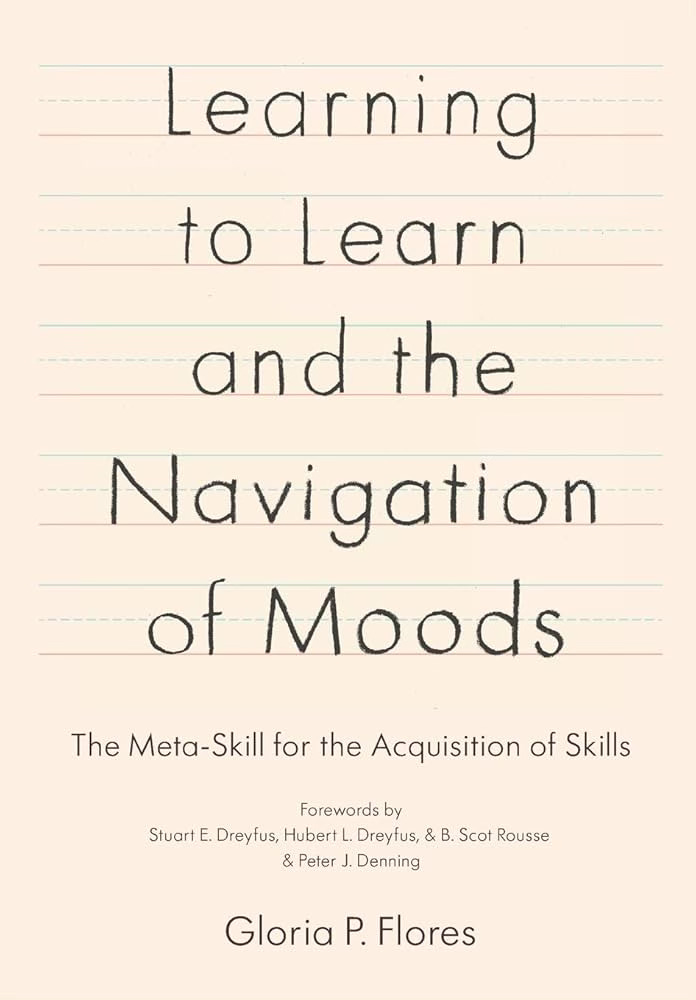
Irreverent and iconoclastic questioning of what is taken for granted as obvious or unquestioned in our society’s common sense, such as our contemporary idolization of optimization, problem-solving and efficiency, or the conviction that the highest goal of life is material success and the comfort of a “white picket fence” (the death of this economic god has been particularly rough on Gen Z according to Scanlon and a big source of its nihilism [see “Gen Z and Financial Nihilism”]), or ontological presuppositions such as the human mind being separate from the body, intelligence being a matter of efficient problem-solving, language being nothing but the processing and transferring of information. (Fernando used to call this the moment of “Ontological detox”)
Pluralistic openness to other, sometimes conflicting, traditions and interpretations of what it means to be human and what is worth caring about. Not just openness, but awe in the face of the vast plurality of interpretation of what it means to be human. (For more on this, see my recent post, “The Manifold Varieties of Mattering”)
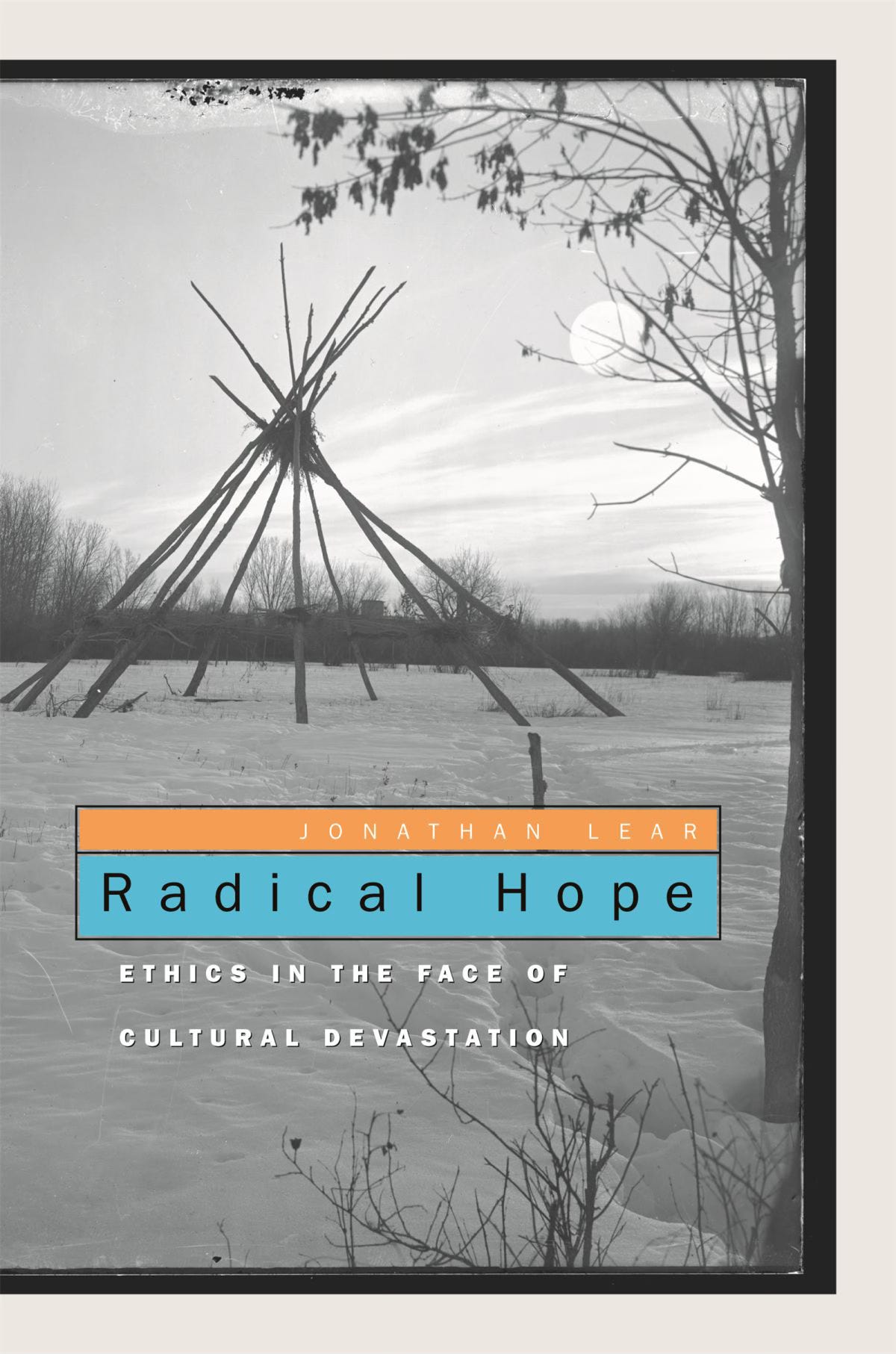
Radical Hope: In face of the disorienting historical ruptures converging in our times (climate crises, the rise of AI, economic chaos, the destabilization of the post-WWII geopolitical order, pandemics, war, genocide), a stand for radical hope: a non-despairing openness to a still unimagined new future whose precise contours we cannot yet foresee; the sense that, no matter what, “we will find a way to go on” amid radical uncertainty and even the possible collapse of our world.
Radical hope is an antidote to fatalism and despair. It is a deliberately cultivated counter-mood against debilitating moods of resignation and resentment that go hand in hand with the nihilism of our times
I have adopted this notion of “radical hope” here from the excellent book by philosopher and psychoanalyst, Jonathan Lear, a book which inspired previous writing of mine with Fernando Flores: “Ecological Finitude as Ontological Finitude: Radical Hope in the Anthropocene,” which appears as ch.10 in a collection of essays called The Task of Philosophy in the Anthropocene.
Thanks for reading everyone! I just passed 500 subscribers here, just in time for my 1-year milestone. Thank you for being along with me on this adventure.
It helps me greatly if you share the link of this page with people you think will appreciate it.
And if you have the means, please consider becoming a paying subscriber to support my ability to carry on this project! You can also leave a one-time tip.
NOTES
Nietzsche, The Gay Science, Preface for the Second Edition. Translated by Walter Kaufmann.
Patricia Benner and Judith Wrubel, The Primacy of Caring: Stress and Coping in Health and Illness (1989), p.1.
The protestant theologian, Paul Tillich, channeling Kierkegaard, uses the phrase “ultimate concern” to get at this phenomenon. See Tillich, The Dynamics of Faith (1957). Dreyfus was a graduate student at Harvard when Tillich started teaching there in 1955 and they became friends. Tillich invited Bert to be the teaching assistant for a class in the Harvard Divinity School in 1959 called “Religion and Culture.”]
See Dreyfus’s discussion of Jesus in his book with Sean Kelly, All Things Shining (2011).
The footnote is on p. 71 of Søren Kierkegaard, Fear and Trembling, trans. Alistair Hannay, Penguin Classics edition.
Hubert Dreyfus, “Christianity without Onto-Theology: Kierkegaard’s Account of the Self’s Movement from Despair to Bliss” (2003), reprinted in Background Practices, ed. Mark Wrathall, p. 2.40.
Dreyfus, “Christianity without Onto-Theology,” p. 242.
Kierkegaard, Fear and Trembling, trans. Alistair Hannay, Penguin Classics, p.79.
See, section 5.2.2 The Danger of Technology; https://plato.stanford.edu/entries/heidegger/.
Karl Löwith: “The Political Implications of Heidegger’s Existentialism,” in The Heidegger Controversy: A Critical Reader. Edited by Richard Wolin. MIT Press, 1993.
This link takes you to the moment in the course where Bert is discussing Heidegger’s notion of ontological death, the experience of losing the ability to carry out the commitments that give you your identity and world (thus bringing you to an experience of the collapse of your identity and world):
Hubert Dreyfus and Stuart Dreyfus, Mind Over Machine: The Power of Human Intuition and Expertise in the Era of the Computer (1988), p. 5.
As I read, I found myself reflecting on Hartmut Rosa's thought and his relevance to your posts. By Rosa, Resonance: A Sociology of our Relationship to the World (2016) and his, The Uncontrollability of the World (2020).
Hey B, I love this piece, in particular how you manage to make Bert’s ideas more (historically) situated via the work of Fernando Flores.