
Heidegger, Skill, and the Conversational Structure of Human Work
The art of staying human in an automated world

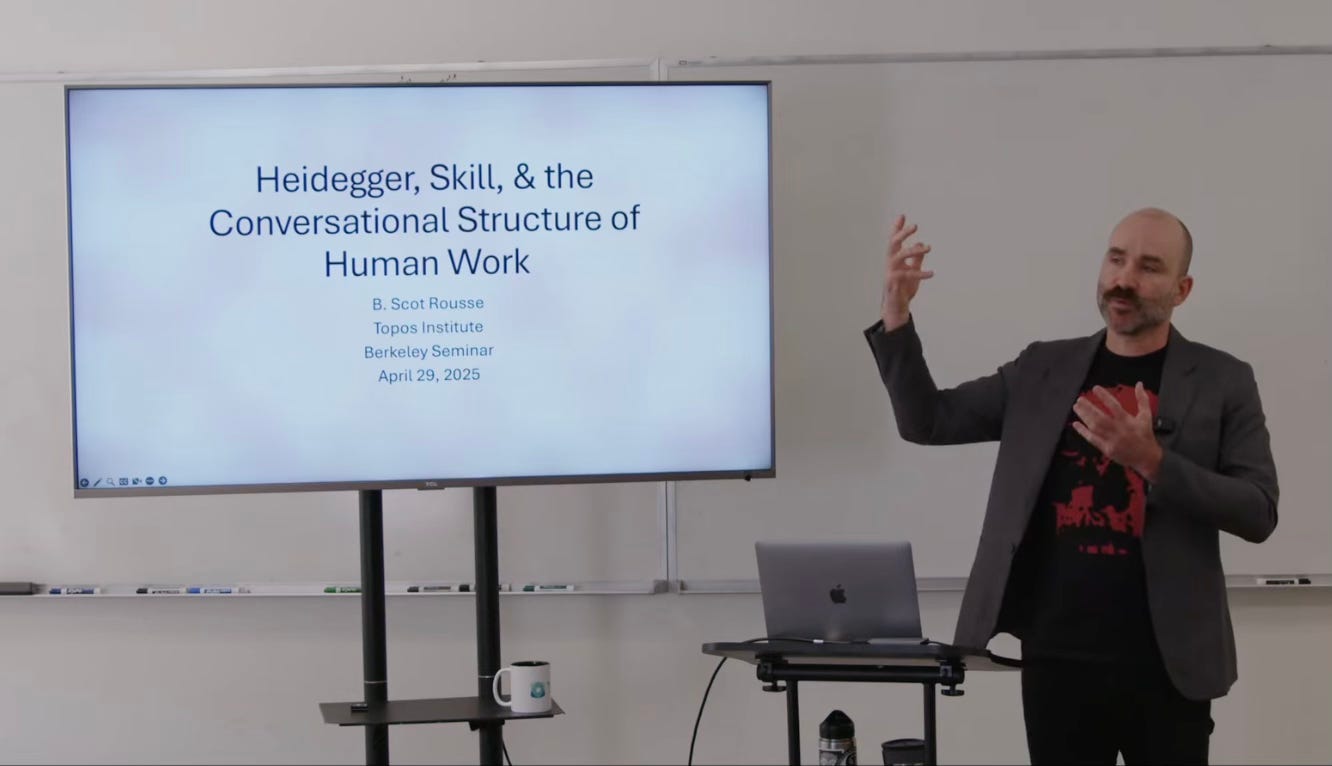
Video of a Recent Talk
I was delighted to be able to give a talk for the Berkeley Seminar of the Topos Institute back in April. The talk is called, “Heidegger, Skill, and the Conversational Structure of Human Work.” Video of it was posted this week on Topos’s YouTube channel.
In the Berkeley Seminar talk, which is designed for work-in-progress presentations, I shared the most recent version of the argument I have been developing for a chapter on “Heidegger and Phenomenological Approaches to Work” that I am preparing for a collection the philosophy of work that will appear through Oxford University Press next year.
Please check it out and leave a comment or question on the YouTube page, or below on this page. I include a short written summary of the talk just below.
The Significance of Human Work
As mentioned, the origin of this talk and post is an invitation I received to write a chapter on Heidegger for a forthcoming collection on the philosophy of work. But instead of confining myself to Heidegger alone, I counter-offered with an essay that traces a whole post-Heideggerian tradition in the philosophy of work—a lineage that reimagines the significance of work, and what it reveals about being human.
See my series of posts on Heidegger!
This tradition begins with Heidegger’s insight that work discloses our being as being-in-the-world: not detached intellects manipulating “external” objects, but intricately interrelated, embodied agents immersed in meaningful practices.
From there, it unfolds through a sequence of thinkers—Hubert Dreyfus, Stuart Dreyfus, Patricia Benner, Terry Winograd, and Fernando Flores—each building upon and going beyond Heidegger’s picture in important ways. Together they show that the significance of work goes beyond the merely instrumental. Everyday work is where our concerns take shape, where our care becomes concrete, and where our commitments are sustained in action.
For Heidegger, work reveals the pre-reflective, embodied familiarity that underlies all thought and knowledge. In Being and Time, his guiding example is a carpenter in the workshop. When the carpenter is absorbed in building, the hammer is not an object of contemplation but an extension of the body, attuned to the task.1
The hammer, the nails, and the project they serve (e.g., building a bookshelf) all belong to a more or less coherent whole of activity and purpose. This is the meaningful context of the ready-to-hand, the world as it shows up in the flow of skilled engagement.
This orientation is social from the start. The carpenter’s work belongs to a community of practice sustained by inherited standards of craft. To be a carpenter is to take part in a living tradition, guided by tacit norms of excellence and proper use of the tools of the trade. Heidegger names this condition being-with: the structure of our ontological interdependence. Even solitary work draws upon this “we,” the background of shared understanding that makes our activity intelligible.2
The post-Heideggerian tradition I am tracing develops this picture in various ways. Hubert Dreyfus, along with this brother Stuart, translated Heidegger’s account into a phenomenology of skill acquisition, describing how understanding moves from detached rule-following to the expert’s intuitive flow of familiarity.3
Patricia Benner extended this framework into nursing, showing how clinical judgment grows through embodied situational responsiveness and care, with care-givers transcending reliance on detached rules and procedures.
Winograd and Fernando Flores extended Heidegger’s analysis of the solitary, tool-using craftsman, confined to a fixed, pre-modern workshop, into the evolving world of the modern office, showing that computers function as “machines for acting in language” within dynamic networks of requests, offers, and promises through which organizational work is coordinated and meaningfully sustained.
What’s at Stake
In an era when machines promise to perform more and more of our tasks, this tradition reminds us that the heart of work is not automation but attunement: the human capacity to sense what matters, to care for what unfolds, and to keep the shared world of meaning from collapsing into mere “output” and “content.”
This helps us see beyond the hype warning how we are on the verge of entering a post-human future of AI-automated work. Instead, we are entering a more demanding future where human involvement matters more than ever. AI may accelerate our ability to complete certain tasks, but it cannot care whether a job is well done, cannot take responsibility for success or failure, cannot discern the standards by which work should be judged. These remain irreducibly human tasks.
If we fail to keep the human contact with care and concern at the center of human work, we are indeed in for some dark times ahead.
See my paper, “Self-awareness and Self-understanding” for a detailed account of how “pre-reflective” action is understood in the tradition of phenomenology.
See my paper, “Heidegger, Sociality, and Human Agency,” for a detailed account of the intrinsically social dimensions of human agency.
See my extended post on the Dreyfus Skill Model (and also its Wikipedia page, which I have authored). See also the updated version of the Skill Model I wrote with Stuart Dreyfus, “Revisiting the Six Stages of Skill Acquisition.”
Your first sentence of "What's at Stake" captures for me the ineluctable relation between sensing what matters and taking care of 'the shared world of meaning' -- thank you for this articulation. This orients for me the notion of listening as receptivity to the dynamic of one's sense of the moment, a particular kind of attuning.
Thanks B, what great insights, as always. Very related to my work on ai-native work environments. Attunement is the word I was looking for when I drafted the post about my project yesterday!
!