
Clarifications of Care
A Response to a Reader Comment

A Note from a Reader
Last week, I received an email from a reader who had the generosity to write and share a thoughtful critique of my “Notes on Care” (co-authored with David Spivak). In that message, he explained why the piece ran afoul of his experience of care and caregiving.
Both David and I found the points he made so compelling that I wanted to share his note publicly and do my best to reply, taking it as an opportunity to offer some crucial clarifications of care.
This matters for my larger project of proposing care as a phenomenon capable of placing the entire conversation about “AI alignment” on more fecund and capacious conceptual foundations. (For more on this project, see my talks, both drawn from collaborative work with David Spivak, “Who Cares About Values?” and “Why Care Matters for AI.”)
The reader, John Robert Niec, kindly gave me permission to share his message and to mention him by name. Here is what he wrote:
Hi B,
Thank you for your essay on care. I read it carefully and with respect for the project you’re undertaking. I wanted to offer a brief reflection on why it didn’t quite land for me.
My experience of care comes from living with my aging parents during hospice. For about a year I was their caregiver, cook, driver, and coordinator as both declined rapidly. In that context, care wasn’t something I discovered reflectively or articulated in advance. It showed up as immediate demands: falls, illness, bodily care, medical decisions, logistics—often with no help and no time. I had to bracket instinctive reactions to discomfort, embarrassment, or disgust and act calmly and competently for their sake.
Reading the essay, I found myself missing the discipline of action that defined caring for my parents. Care showed up as something you do, not something you contemplate. Caregiving was emotionally and spiritually maturing, but in a practical way: it required judgment, steadiness, and follow-through under pressure. I don’t doubt the insights you offered, but they felt distant from the practice that shaped me.
Care is doing what is required, well.
Best,
John
First of all, I would like to thank John again for taking the time and care to write and share his reactions to “Notes on Care.” David and I aspire for our work on care to honor and emphasize what John experienced. To the extent that John found our articulations lacking on this front, we failed to adequately present our case.
I’d like to pull out three themes from John’s email that call for further discussion:
What John calls “the discipline of action” involved in caring; the fact that caring shows up “as something you do, not something you contemplate”
The distinction between care and caregiving
The emotional and spiritual “maturation” that John underwent in his experience of caregiving
1. “Care is doing what is required, well”
John concludes his email to me with an elegant and punchy one-liner: “Care is doing what is required, well.” He read “Notes on Care” as conveying a picture of care as something “discovered reflectively or articulated in advance.” John found in our piece an overly-intellectualized distortion (though he didn’t put it quite that way).
I take it that there are likely two aspects of “Notes on Care” that contributed to this impression.
First, “Notes on Care” is a reflective, philosophical articulation of the nature of care. This already puts it at some distance from the phenomenon it is seeking to portray. Among the deleterious side-effects of writing such reflective articulations is a tendency to over-intellectualize and thereby distort the phenomenon in focus.
In fact, the whole discipline of phenomenology as a philosophical method is aimed at this puzzle: how do you bring to reflection and articulation that which normally happens without reflection and articulation, including, especially, our everyday, pre-reflective activities, guided as they are by what we care about?
I’m trained in the discipline of phenomenology, and always striving to get better at staying close to the phenomena (“what appears”) in my writing. This is not easy! The temptations of intellectualization and conceptual beauty are always ready to distract me.
Second, “Notes on Care” does insist on a connection between care and linguistic articulation:
Our cares get provisionally articulated in language, but the articulation is never the whole story. We need language to coordinate with others, to understand and to explain ourselves, to work out what we’re up to. But these articulations are always provisional, always approximations of something deeper . . .
Sometimes, the very attempt to say “what’s the matter” changes our sense of what the matter is. I may be initially drawn to articulate my emotion as anger only to realize I am insecure and jealous. The words we use to describe what we care about lurk at the place where language both reveals and conceals. This is part of why values, which present themselves as fixed articulations, miss something essential about care.
It must have been these passages that stood out for John and gave the impression that care, in our picture, emerges through a reflective discovery or advance articulation, rather than just being directly expressed in how someone responds to what the world throws at them.
And so it is important to emphasize John’s observation: caring is manifest first of all in how we act, not in how we think of or talk.
We do not first construct a theory of care and then apply it to life. We find ourselves already entangled in situations that solicit us. Something happens, and we are drawn into action. We perceive the world, sensing what is possible and required, in light of what we care about.
“Requirement” here is not the same as preference. It is not the same as inclination. Nor is it simply the imposition of an external rule. To experience something as required is to find oneself addressed. The situation makes a claim.
Our identity as a particular person is enacted in our responsiveness to these claims the world makes on us. A teacher confronted with a student in distress does not begin by consulting her values statement. The situation polarizes into what must be addressed now and what can wait. A parent hearing a crash in the next room does not deliberate about whether caregiving aligns with his highest priorities: he just moves.
Indeed, this forms the whole basis of the insistence that David and I place on a distinction between care and values (as this latter notion is taken for granted in the current conversation about how to “align” AI with “human values”).
Values are precisely a product of reflection and conceptualization, and for this reason might not adequately reflect or capture the underlying care that amounts to a person’s basic orientation in the world (how they directly respond to what the world throws at them).
Heidegger insists that understanding what a situation calls for is not primarily a matter of having the right concepts in one’s head, but is a matter of ability, competence, know-how. The carpenter understands the workshop by skillfully navigating it. The jazz musician understands the performance by hearing where the song is going and adjusting in time. Their understanding is not hidden inside or listed on a table of values; it is manifest in what they can do.
Care is not first a feeling, nor a value, nor a principle. It is a way the world shows up as making claims upon us. What is required appears within a field of concern that we are already inhabiting. We are not detached observers deciding whether to enter the fray. We are already in it. “Care is doing what is required, well.”
The “well” that John adds matters. One can do what is required poorly. One can meet the demand resentfully, mechanically, or inattentively. The “well” names a quality of attention, attending, and appropriateness that cannot be reduced to speed or efficiency. It names the difference between executing a function and tending to a situation in a way that honors what is at stake.
“Doing what is required, well” is not the language of optimization. Optimization seeks maximal efficiency according to predefined metrics. The “well” in John’s sentence names something different: it names attunement.
Care, understood in this way, is not simply opposed to reflection. It is reflection that has sunk into the body, into the perception of what this situation requires, into habit. It is practical wisdom, forged through involvement. And it is precisely this structure that John’s sentence illuminates.
In my scholarly work in phenomenology, I have written many pages about the inter-relations between our “pre-reflective sense of self,” as manifest in how we spontaneously act and respond to what life throws at us, and our “reflective self-interpretation.” This is our attempt to actively “make sense of” and “get a grip on” who we are and what we care about, undertaken in linguistic self-reflection and conversation.
Who you are as a person is first and foremost realized in how you unthinkingly respond to the situations that life throws at you. This shows what you are made out of; it reveals what you care about, when it comes down to it. But you are never just stuck with how you already are.
Human beings have a power to rise to the occasion and transform their basic pre-dispositions for acting in and responding to the world. John and the tradition of existential phenomenology are in agreement on these important and stirring points.
See my papers, Self-awareness and Self-understanding, and Existential Selfhood in Merleau-Ponty’s Phenomenology of Perception for my scholarly treatment of these themes.
… But now I need to do better at bringing these distinctions and this phenomenology out of the scholarly journals and into my writings here at Substack.
Here, again, are some of the first few sentences in “Notes on Care”:
First and most fundamentally, care is a way of being in the world, to use Heidegger’s phrase. Caring is not something we have, like values we can list. It’s something we do and something we are.
David and I tried in this way to emphasize this primacy of action and involvement, but this perhaps gets lost in the details and the conceptual elaborations of our writing. In “Notes on Care,” we used the following catchy slogan that David came up with for crystalizing our view:
“Caring is tending and attending to what matters.”
This is our version of John’s phrase, “Caring is doing what is required, well.” However, there are some slight differences in emphasis between these two articulations.
John’s version emphasizes rising to the occasion of what is required, where this might call on us to overcome hesitancies and discomforts, and even to develop new skills and capacities that can be genuinely transformative of who we are (see point #3 below, regarding what John called his “spiritual maturation” in the experience of caregiving).
David and I did not highlight these aspects of what John calls “the discipline of action” in caring. But he is right that when the chips are down, this is exactly the mode of behavior through which care comes alive and reveals itself in human life. Tending and attending to what matters isn’t always as easy and flowing as David and I made it out to be in our earlier notes.
2. The distinction between caring as such and caregiving
In “Note on Care,” David and I are operating at a higher level of abstraction than John’s experience of being a caregiver for his aging parents. David and I are exploring the domain of caring as such, or what it means to be the kind of agent who is capable of care.
We are trying to bring out the contemporary relevance of the broadly existentialist idea that to be human is to be thrown to concerns of meaning and purpose. In Heidegger’s phrase, being human means that “our own being is an issue for us”: we can’t help but be moved by a sense of what matters, beyond what we just “want” or “prefer.” I want to show how engagement with such issues could help provide richer philosophical frameworks for contemporary discussions of AI alignment.
I don’t have this distinction carefully worked out yet, but let me try this: caregiving as John lived it is one of the most intense and concentrated manifestation of the more general dynamics of caring as such. I think this accounts for some of the difference in emphasis in our articulations of care.
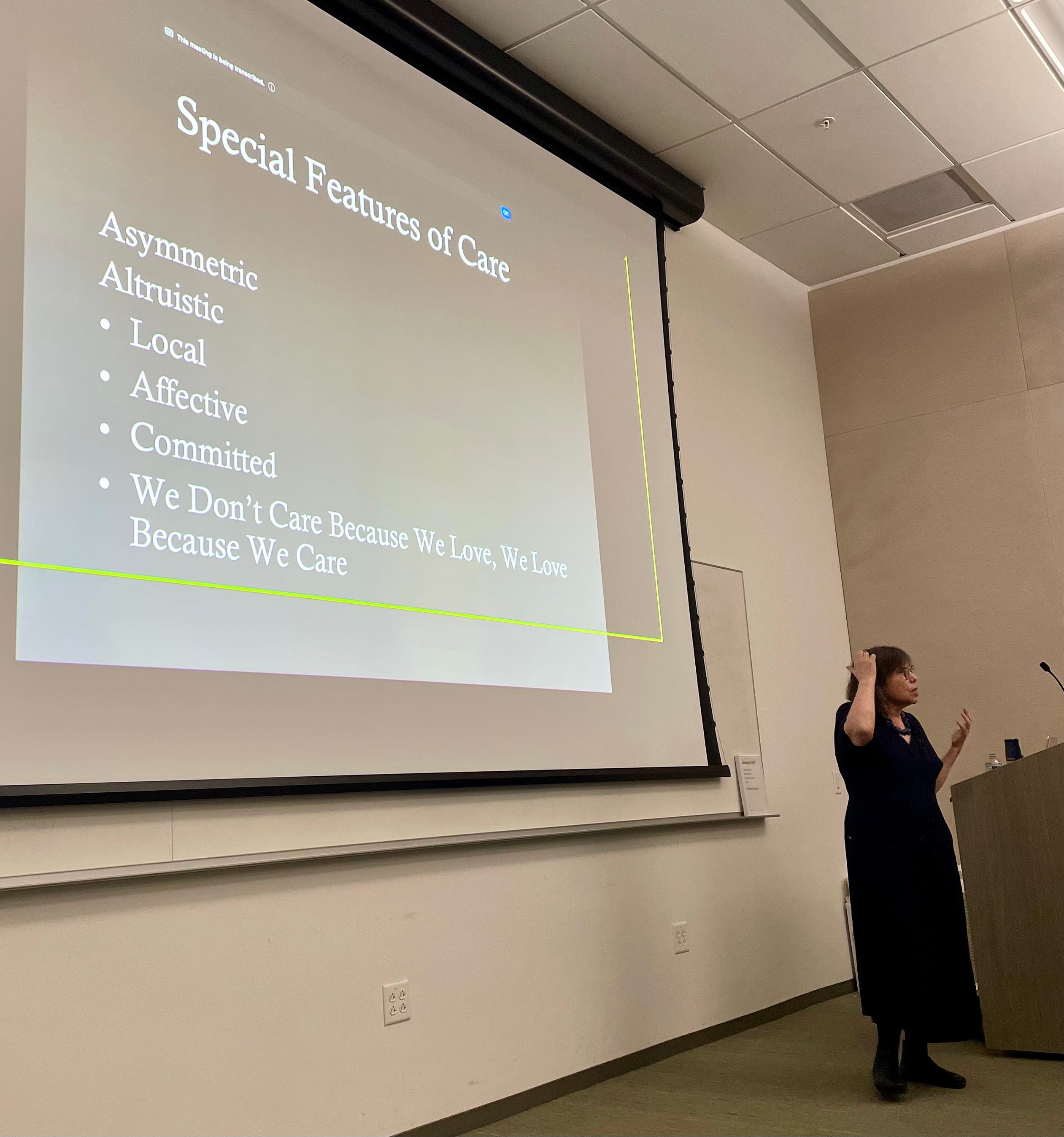
Here is a picture of an illuminating slide that Professor Gopnik shared in a recent talk I saw her give at Berkeley (again, see my recent write-up of this). I think this slide reveals some dimensions that David and I left out of our account of caring as such, but that are important for John’s particular experience of caregiving, particularly the asymmetric and altruistic characteristics.
Wrestling with the distinction between caring as such and caregiving
The distinction between caring as such and caregiving as an expression of care was recently brought home to me by my engagement with the current work of the celebrated Berkeley psychologist, Alison Gopnik (which I wrote about here recently).
Professor Gopnik has been going around compellingly arguing that practices of caregiving demand more attention and study, especially given their relevance for contemporary discussions of AI and the problem of AI-human “alignment.”
That being said, in the Q&A session after a recent talk I attended by Professor Gopnik, she was hesitant about the distinction I proposed between caring as such (an orientation to concerns of existential meaning and purpose) and caregiving (where the latter is a particularly intense and concentrated manifestation of the former).
She suggested that since a caregiver is often drawn to completely subordinate their own personal well-being to the well-being of the one cared-for, then caregiving can cut against what a person otherwise cares about. But I see this simply as confirmation that caregiving is a particularly intense way of enacting the nature of care as such.
This distinction between caring and caregiving, as I understand it, both echoes and diverges from one made by Nel Noddings between “caring about” and “caring for” (see Noddings, Caring: A Relational Approach to Ethics and Moral Education, 1984).
There is much more thinking to do about all of this.
3. Caregiving and spiritual maturation
The third theme John presented in his email that I found very much worth emphasizing is his observation that
“Caregiving was emotionally and spiritually maturing, but in a practical way: it required judgment, steadiness, and follow-through under pressure.”
Nothing in what I’ve written so far about care has managed to capture or sufficiently engage with this self-transformative dimension of caregiving. I express my gratitude again to John for offering this for my tending and attention.
Thanks for reading! I enthusiastically welcome more reader comments and questions.
Hey B!
I’ll have to read more of your posts and papers. At this point I am wondering how critique and self determination fit into your approach. It’s a deep insight that we are thrown into our worlds and that pre-reflective caring is important - a core human need and good. But humans often feel impelled to respond in ways that on reflection we see as less than best or bad. I’m sure Albert Speer cared about building great architecture for the third reich. And some people who feel compelled to care for others fail to figure out how to live a good life of their own. So we need an account of critique and self-determination to understand what good human living is like. It seems that AI is problematic in good part because it enables and perhaps incentivizes the all too human tendency to flee from the difficult task of achieving real human freedom. Caring is a basic need, but not enough for freedom. Well that’s my take. Curious to hear your thoughts.
Hi B,
Thank you for the clarification piece and for the original one. Will you produce a new piece on caring to revise your original?