
"What You Want is Boring."
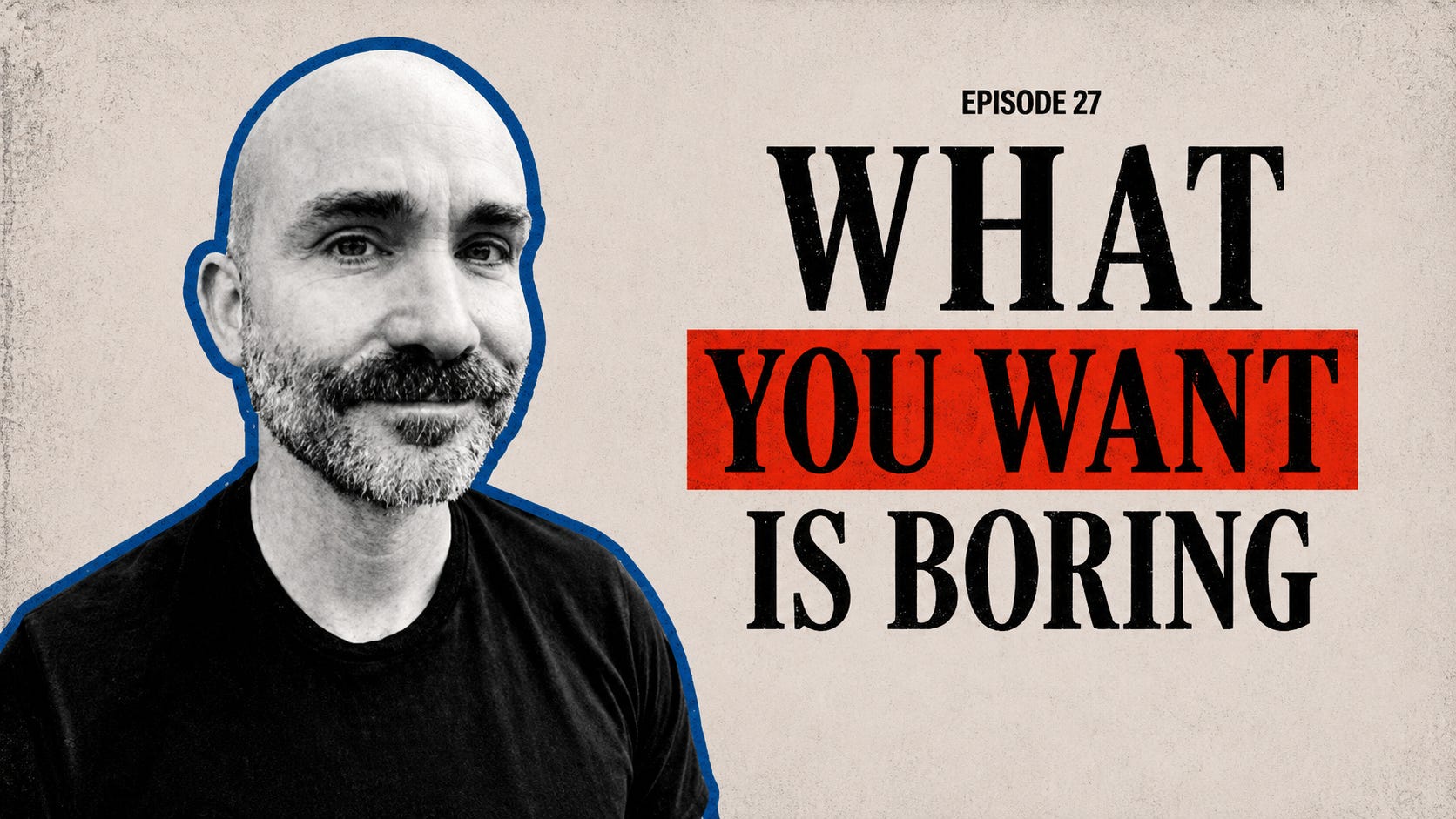
A recent podcast conversation about how AI will impact families and wellbeing. And an explanation of why what you can offer is more vital than what you want -- according to Fernando Flores.

Check It Out
I was recently a guest on a new-ish podcast called The Family Wealth Edge. The hosts and I had a wide ranging conversation about the possible impacts of today’s “generative AI” on human life, relationships, and families. Thanks to the hosts, Vincent Valeri and Kristen Heaney for having me on!
I met Vincent at the end of 2024 when he was a student in a class I was teaching at Pluralistic Networks, the consulting and professional development company where I was director of research until April of 2025. The name of the class was Ambassador of Possibilities, a phrase coined by my dear friend, mentor, and ex-boss at Pluralistic Networks, Fernando Flores.
Here is the description of the podcast episode, with a link to view our conversation just below. After this, I provide some historical and philosophical context for the “Ambassador of Possibilities” course, and the quip the producers of this podcast chose for the slug line of the episode, “What you want is boring.”
Podcast Episode Description
We sat down with philosopher, coach, and punk rock drummer B. Scot Rousse for a conversation about the implications AI will have on our humanity.
What we get into:
Why “what you want” is the most boring question you can ask about your life, and what to ask instead
Cognitive offloading: the real danger of outsourcing not just your emails, but your ability to think to machines
The slot-machine loop, “AI slop,” the traps hiding inside every chatbot
An actionable four-part framework for a meaningful life in the age of the machine
What raising kids with AI has in common with raising kids with wealth
Watch it here:
Historical and Philosophical Background: Fernando Flores and the Self as a Source of Offers
How did I end up as a guest on a podcast that describes itself as “a series for inheritors, wealth creators, and complex families navigating the emotional, relational, and purposeful side of money; where legacy, identity, and meaning matter more than the balance sheet”?
As mentioned, I met Vincent, one of the hosts when he was a student in a class I was teaching at Pluralistic Networks, the consulting and professional development company where I was director of research. The name of the class was Ambassador of Possibilities, a phrase coined by my dear friend, mentor, and ex-boss at Pluralistic Networks, Fernando Flores.
I met Fernando through Hubert (“Bert”) Dreyfus right as I was finishing my PhD in philosophy (see my remembrance of Bert here). I was dazzled by Fernando’s ability to do philosophy, to make philosophy come alive in how people live and work. For Fernando, philosophy is not just thinking about philosophical ideas, it is designing ways of being and doing.
Fernando makes philosophy come alive by translating philosophical ideas into embodied skills and practices to help people expand their ability to relate to each other, their existential wellbeing, and their ability to effectively enact their care.
His ability to do this is fed by his own vast practical experience which he brought with him already to his PhD studies at Berkeley with Hubert Dreyfus, John Searle, and Stuart Dreyfus. Flores's thesis was titled Management and Communication in the Office of the Future. Drawing from Searle’s theory of speech acts and Dreyfus’s interpretation of Heidegger’s ontology, Flores presents a creative and practice-guiding theory of management that is grounded in an ontology of the workplace as a network of conversations oriented to taking care of people’s concerns.
Fernando arrived to Berkeley after a one-year position at Stanford, where he had arrived in 1976, driven into exile after being held as a political prisoner for three years under the Pinochet regime in Chile. Fernando was Finance Minister in the Allende administration in the early 1970s, and later the Secretary General of the Government. On the day of the Coup, September 11, 1973, he was at the presidential palace alongside President Allende while the military bombed the place.
Before being appointed Finance Minister, Flores was responsible for launching and overseeing Project Cybersyn, “one of the most ambitious applications of cybernetics in history” (Eden Medina, Cybernetic revolutionaries: technology and politics in Allende’s Chile.) This was the project that put Fernando on Stanford’s radar and prompted Stanford’s Computer Science department to offer him a one-year position there after he got out of prison. “From prison to Palo Alto,” Fernando sometimes says with a wry, incredulous smile.
After going on to get his PhD at Berkeley (in just three years), Fernando published Understanding Computers and Cognition: A New Foundation for Design, with Terry Winograd, and he went on to become an entrepreneur, doing projects in software design, education, and business consulting. Indeed the philosophical foundations for the first phase of his entrepreneurial work are laid out in the book with Terry. Fernando also later served as a senator in Chile in the early 2000s.
Being a philosopher (along with being an engineer and entrepreneur and former politician), Fernando is the kind of character who likes to have a philosopher on his team.
A couple of months after meeting Fernando through Hubert Dreyfus for a pizza one sunny Sunday afternoon at Dreyfus’s house in the Berkeley Hills, I was on an airplane to Santiago. Fernando had invited me to be a researcher on his team for a report he was writing on innovation for the Chilean government (the report was commented on in the WSJ and in the WSJ reporter's personal blog)
When Fernando moved back full time to California around 2014 I then joined his team as the full-time “staff philosopher” at Pluralistic Networks. The “Ambassador of Possibilities” course was one of the programs we offered.
Fernando used the phrase “Ambassador of Possibilities” to describe someone who was adept at the conversational and relationship skills people can use to open possibilities and illuminate new futures for other people.
“What you want is boring.”
In fact, I am essentially quoting Fernando, and the overall approach of the Ambassador of Possibilities course, in the one-liner that the producers used for the slug line of the podcast episode I am sharing here: “What you want is boring.”
Fernando said a version of this line to me pretty early in our working relationship. I was explaining to him how I wanted some flexibility in asking for time off from work because, something to the effect of, “I want to be able to live a life where I pursue my career, but also play music and travel with my band.”
Fernando stopped me and said something like: “B, don’t approach life with the question of what you want. That will make you a narrow person. Approach life with the question of what you can offer the world and others.” As Fernando often said in his courses, “Offering is the ticket to the adventure of life.”
The surface grammar of these sayings may not reflect their philosophical depth. In fact, what Fernando is saying here grows out of his way of re-interpreting speech act theory in light of Heidegger’s ontology of human existence.
Offering is one of the five basic kinds of speech acts (along with requesting, asserting, declaring, and, depending on whom you ask, either expressing or assessing). For Searle, offers, or what he calls “commissives,” are a particular speech act by which a speaker commits to a listener to do something for them.
Fernando sees offers as the primary means by which a person shows what they care about and who they are in the world. The offers we make to others create our future, and concretely shape how we show up in the world and make a difference in the lives of others. In a very real sense, who you are is defined by the offers you make (and keep) to the other people in your life.
You realize what you care about by making and keeping offers. Ontologically speaking, the self is a source of offers. When an offer is accepted, it becomes a promise (when a request is accepted, it also becomes a promise on the part of the person who accepts it).
The Ontological Power of Promising
Promises are the means by which we co-create our worlds and our futures.
As Hannah Arendt put it in The Human Condition
“Without being bound to the fulfillment of promises, we would never be able to keep our identities; we would be condemned to wander helplessly and without direction in the darkness of each man’s lonely heart, caught in its contradictions and equivocalities.”
Nietzsche was also in awe of our power to promise:
“To breed an animal with the right to make promises—is not this the paradoxical task that nature has set herself in the case of man?” — On the Genealogy of Morality, Second Essay, §1
What about Heidegger?
Heidegger thought of human identity as what he called a thrown project [geworfene Entwurf]. We are thrown into a world, historical context, a family, a language that we did not choose and set the inescapable context of our lives. Thrownness captures the way the past “always already” weighs upon and conditions us.
Yet within this thrown setting, we project a future by committing ourselves to identities and projects that define who we are, define the stand we take on the question of who and how to be in the world. An identity that you are committed to is never something you are “done” with; it always projects a future, as long as you are committed to it.
For example, as long as I’m committed to being a drummer, there are always more songs to write, more bands to start, more shows to play. Our identities, commitments, and relationships draw us into the future and they are “always outstanding” — never settled and done, at least as long as you care about and define yourself through them.
What Fernando points out is that undertaking any and all of these activities through which we carry out our identities and connect with what is important to us involves a whole array of conversations, and among the most important of these are offering and promising.
As a band, when you agree to play a show, you make a promise to be there. When you agree to set up the show for a touring band, you make a whole array of promises: there will be a venue, you will charge money so you can pay the band, there will be a PA so the vocals can be heard, there will be opening bands, you will make a flyer to advertise the show, and so on and on.
Fernando reads the projection of your identity in terms of the offers and promises you make and realize in the world. The concrete projection of the self into the future that Heidegger focused on is carried out by offers and promises. The stability of the self in relation to others is also grounded in our ability to make and keep offers and promises.
When we were doing the pilot program for the first Ambassador of Possibilities course not long after I joined Pluralistic Networks, Fernando broke the participants up in groups and had us do an exercise (even though I was helping deliver the course, I was also taking the course at the same time, since I was just beginning to learn Fernando’s frameworks for consulting and coaching).
The instructions were to interview your counterpart about their current concerns, and then make an honest offer to them about how you could help them take care of their concerns. In the context of this exercise, I realized I had never taken seriously the awesome power of creating my world and identity through the offers I could make.
I had never consciously tried to make a meaningful offer to anyone. I had been living in a sort of passive resignation about my own personal powers of self-projection, notwithstanding the fact that I was a scholar focused on the ontology of self-projection! (My PhD thesis was called: Thrown Projection: An Interpretation and Defense of the Hermeneutic Conception of the Self in Heidegger’s Being and Time.)
This hit me like an ontological thunderbolt and I look back at it as one of the most formative and empowering philosophical-practical realizations of my life; a moment in which I started to graduate from seeing myself as “just” a philosopher who can explain things and make requests for funding or jobs, to seeing myself as someone who is a source of offers and thus possibilities for others and the world. Rather than waiting for the world to give something to me, or my boss to agree to “what I want,” I could see myself as a proactive participant in the co-creation of the world through making offers grounded in what I care about. This, in a word, is one of the main lessons of the whole Ambassador of Possibilities course.
Towards the end of my time with Pluralistic Networks, would eventually go on to be the primary instructor of the Ambassador of Possibilities course. This is where I met Vincent Valeri who was a student in my class. Vincent went on to start a podcast called The Family Wealth Edge on which he invited me to be a guest a few weeks ago to talk about the impact of AI on families and wellbeing. Please listen to the episode in light of this philosophical and personal backstory!
Punk Show This Friday in Oakland
If you are in the Bay Area, join me at this show on Friday in West Oakland at The First Church of the Buzzard. My band VEXXYL is playing first, around 9pm. The event is a showcase for one of our most prolific and important DIY punk-metal labels in Oakland, Transylvanian Recordings (who are releasing the Vexxyl demo).
DM me for the address.

If what you want is boring, we can only imagine the bouquet of feelings that appears when an offer meets reality 😀 and it starts to be tested and refined in response to reality. See you tonight! 🎶