Uncanny and Phenomenological Beginnings to 2026
This weekend, existential philosophers gather in an isolated desert town on the shores of an evaporating inland sea.


The photo above is taken by photographer, Kevin Key of Bombay Beach, CA. Follow his art and activities on TikTok and YouTube.
Behold Zig Zag Plaza on the edge of Bombay Beach. The yellow double-decker storage container will be the seminar room for the 2026 meeting of the American Society for Existential Phenomenology (ASEP), which starts tomorrow morning.
ASEP is a group founded in the early 2000s by Hubert Dreyfus and some of his PhD students. I joined in 2012, right after receiving my PhD. We meet yearly, historically gathering at major universities where many of our members teach. But last year we went for something different: we convened in this surreal little town on the eastern shore of the Salton Sea. And it was so jarring and welcoming that this year we’re here again.
Our connection to this place runs through Tao Ruspoli, the director of the wonderful philosophical documentary and essay film, Being in the World (fully available for free on YouTube), based on Hubert Dreyfus’s interpretation of Heidegger. Tao is the co-founder, with Dulcinée DeGuere, of The Bombay Beach Institute, which is hosting ASEP.
I was last in Bombay Beach back in April 2025, when I gave a version of my paper, “Frictionless Spinning in the Void: Why Humans are not LLMs,” at an arts and philosophy event put on by the Bombay Beach Institute called CONVIVIUM.
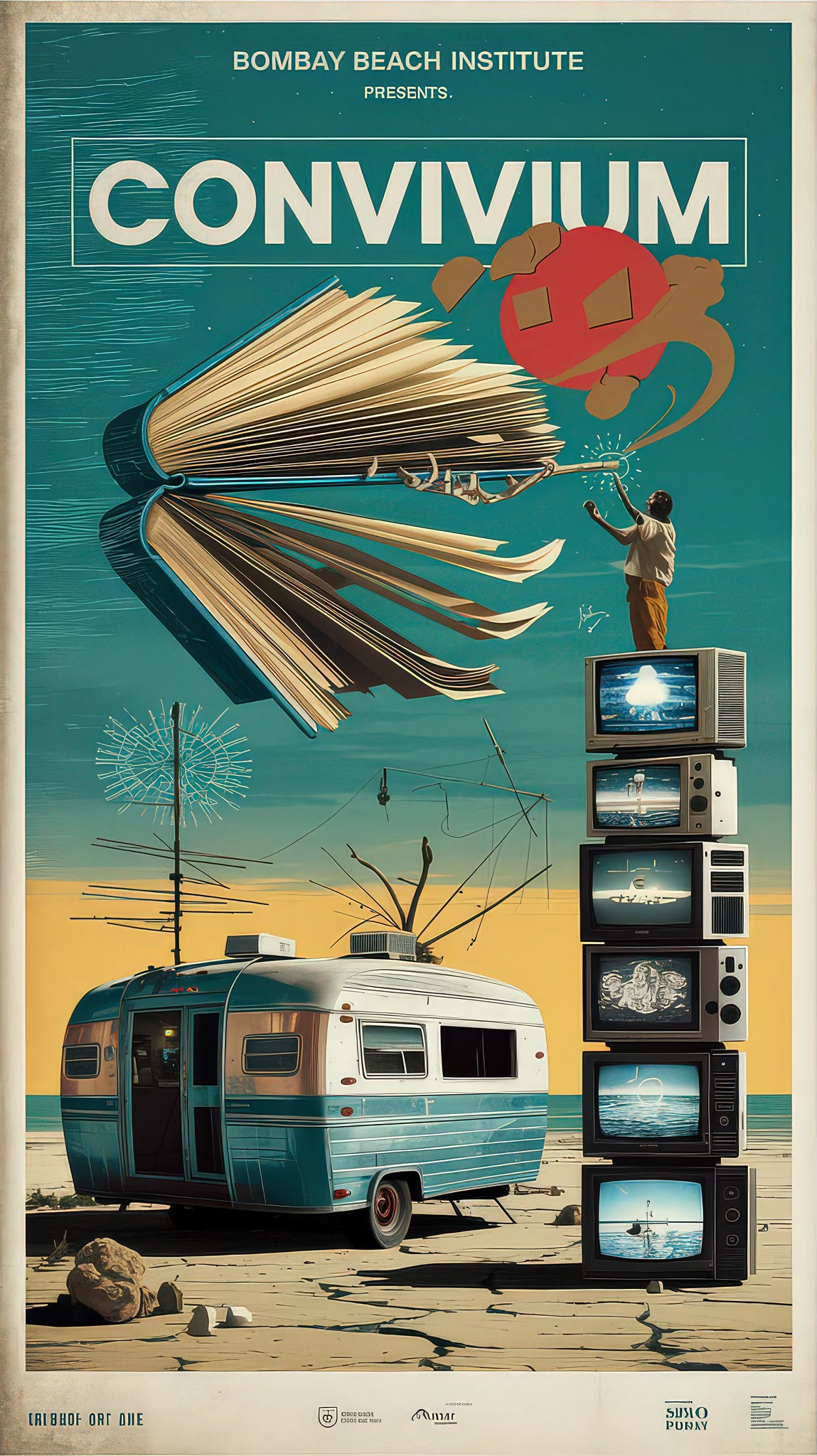
While here then, I joined Tao on his podcast, which is also titled Being in the World. See the video here and my brief write up here. Among many other things, we discussed why this town works so well as a staging ground for philosophy.
A Fittingly Uncanny Place for Philosophy
There’s something about the place that is bountifully unsettling. And it’s not just the sulfuric whiff of the Salton Sea stench.
When we’re at home in our familiar environments, we have an easy sense of relevance. We can tell what to pay attention to and what can be ignored. That’s what Heidegger calls our everyday being-in-the-world, the flowing familiarity that lets us act without thinking about it.
But Bombay Beach destabilizes all that. Here, elements of reality that don’t normally mingle get intermangled, especially when you are conducting a philosophy conference. You’re sitting around a table, in a double-decker storage container, listening to a paper on Heidegger’s interpretation of Nietzsche, and then you look out and see a guy in a tuxedo drive by on a dilapidated bicycle almost colliding with dune buggies flying Trump flags.
Then your eye is caught by a giant egg-nest sculpture perched atop someone’s roof, and a pile of industrial detritus doubling as a work of art, or just junk. The familiar and the unfamiliar merge in strange ways. The foreground-background structure of our perceptual field gets wobbly, and every detail seems to pop.
The place is oozing with weird visuality. The town’s perfect grid grinds against thwarted visual expectations. You can’t rely on your normal sense of what’s relevant and what’s irrelevant, what’s art and what’s garbage, what you should interact with and what you should avoid. Though you should avoid the mud.

Bombay Beach disorients but welcomes. There’s something philosophically fitting about this.
According to the theory of skill acquisition developed by Hubert Dreyfus with his brother, Stuart (the Dreyfus Model of Skill Acquisition, Wikipedia article curated by me), one difference between an expert and a master in a domain is that masters seek to push the limits of their abilities and familiarity.
Masters move beyond expertise into mastery by actively adapting to change, seeking out unfamiliar situations, expanding beyond the confines of their comfortability, and enriching their repertoire of intuitive responses.
But we can do this in everyday life too. In everyday life we can become stuck in stultified habits of attention, a reified comfortability, a narrowed horizon keyed to the requirements of our daily grind.
As Robert Bellah noted in the beginning of Religion in Human Evolution, “one of the first things to be noticed about the world of daily life is that nobody can stand to live in it all the time. Some people can’t stand to live in it at all.”
To loosen the hold of the “dreadful immanence” of everyday life (another phrase from Bellah), occasionally we need to find moments of transcendence, immersion in the uncanny. Bombay Beach has deep reservoirs of uncanniness. Whiffs of wonder whaff into your face. Or was that cat pee?
This Weekend’s Program
At this year’s meeting, top scholars of existentialism and phenomenology will present new work. Papers include explorations of Simone do Beauvoir on the collective constitution of the social world, Frantz Fanon on the body schema and colonial oppression, Walt Whitman on how to hold contradictions in tension; philosophical reflections on loneliness, studies on how neuroscientists and phenomenologists try to learn about what is “normal” from what is “pathological,” and papers dissecting Heidegger’s interpretation of Nietzsche.
My Paper: “Why Not Brain Rot”
On Saturday afternoon, I’ll present a paper called “Why Not Brain Rot.” This is a refined and re-composed version of ideas I’ve been exploring here lately
The paper starts from a provocation: those who worry that AI is eroding human autonomy are barking up the wrong existential tree. Autonomy only matters in the midst of a meaningful life.
Young people today laugh and cringe about their addiction to “brain rot”: idiotic, meaningless videos and images circulating on the internet, content that renders one willingly stupid and stupefied. The term was Oxford’s word of the year for 2024.
So, why not brain rot? Revelry in brain rot is a response to a world that is hostile to meaningful involvements, while being rife with “content” and endless distractions: a nihilistic world.
What we need in order to flourish in our brain rotting times is not more answers, certainty, control, or even more autonomy. What we need is a revitalization of our capacities to care. That path is involvement: the receptive, vulnerable, historically-situated work of attuning and tending to what matters now, with others.
I’m planning to make a video my talk and will share it here when it’s ready.
Two Viewing Recommendations
Before I go mingle with the philosophers, I have two viewing suggestions for those following developments in AI.
1. Dwarkesh Patel: “What Are We Scaling?” I.e., “Thoughts on AI Progress” (Dec 2025)
Dwarkesh Patel, whose podcast is essential listening for keeping up with the vibes and happenings in AI, published a year-end reflection on AI progress that’s worth your time.
In about twelve minutes, he lays out a thoughtful skepticism about the imminence of AGI, focusing on the gap between what current systems can do and what actual human-level, flexible, general intelligence requires.
His key point is that the AI companies are currently trying to bake specific skills into models with custom training for every micro-task. But what we actually need in order to reach AGI is a system that can continually learn from experience and generalize across evolving situations the way humans do everyday.
I previously had Patel tagged as someone who recurrently bought too much into the hype machine of Silicon Valley, but this post shows that either I was wrong about that or that he has been evolving his views.
2. The Thinking Game
My second recommendation is The Thinking Game, a moving documentary about Demis Hassabis and Google DeepMind.
It gives an inspiring portrait of Hassabis, from his childhood as a chess prodigy, to his work on one of the most successful video games ever (Theme Park) at seventeen, to his PhD in cognitive neuroscience, to co-founding DeepMind with one messianic mission: to “solve” intelligence. While this goal remains elusive, the documentary takes us through the breathtaking breakthroughs of AlphaGo (Move 37!), AlphaZero, and then especially AlphaFold along the way. I highly recommend it. Next week I have a whole post commenting on it in more depth.
Thanks for reading! Please share the link with a friend who might be interested.
Also, please support my work for the Hubert Dreyfus Audio Archive: