
Two Lectures on Phenomenology
And a trip to Paris for Safe and Ethical AI

Safe and Ethical Approaches to AI in Paris
This week I’m in Paris for the meeting of the International Association for Safe and Ethical AI, a “conference [that] will bring together an interdisciplinary community of researchers, policymakers, industry leaders, and practitioners committed to ensuring that AI technologies are safe, ethical, and beneficial.”
I’m enthusiastic to participate. In a near-future post, I’ll write some notes about my experience here. Researchers far and wide, as well as AI luminaries such as Joshua Bengio, Geoffrey Hinton, and Stuart Russell will be giving talks. There is a simply massive program of panels and workshops for three full days.

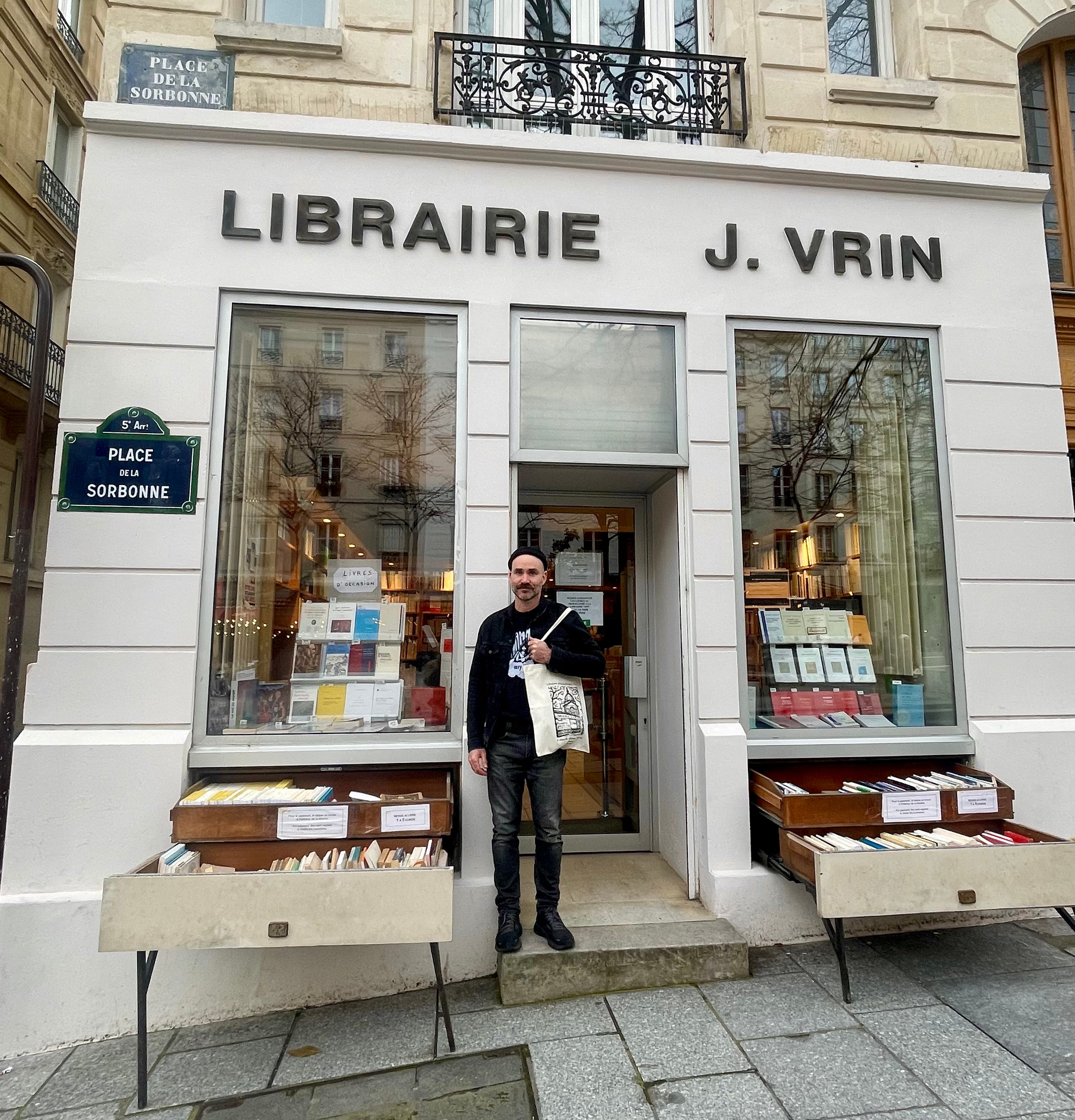
One of the first things I did upon arriving in Paris was visit the J. Vrin Philosophy bookstore (an all philosophy bookstore), located right at Place de la Sorbonne. I stumbled upon this bookstore when I lived in Paris during graduate school (courtesy of Northwestern’s Paris Program in Critical Theory), acquiring here used copies of a couple key editions of Heidegger’s Gesamtausgabe that were in indispensable for writing my dissertation (in the days before such pdfs were readily available online). I always make the pilgrimage to J. Vrin anytime I’m in the city.
I’ve never been to any other all-philosophy book store—exquisitely and lovingly organized and stocked (although the bygone University Press Books that used to be on the southern edge of UC Berkeley campus was a similar haven).
New Phenomenology Lectures on my YouTube Channel
While I’m in Paris thinking about safe and ethical AI, I’ve cued up a few new additions to my playlist of Phenomenology & Existentialism Lectures on my YouTube channel (both of which are still in their infancy).
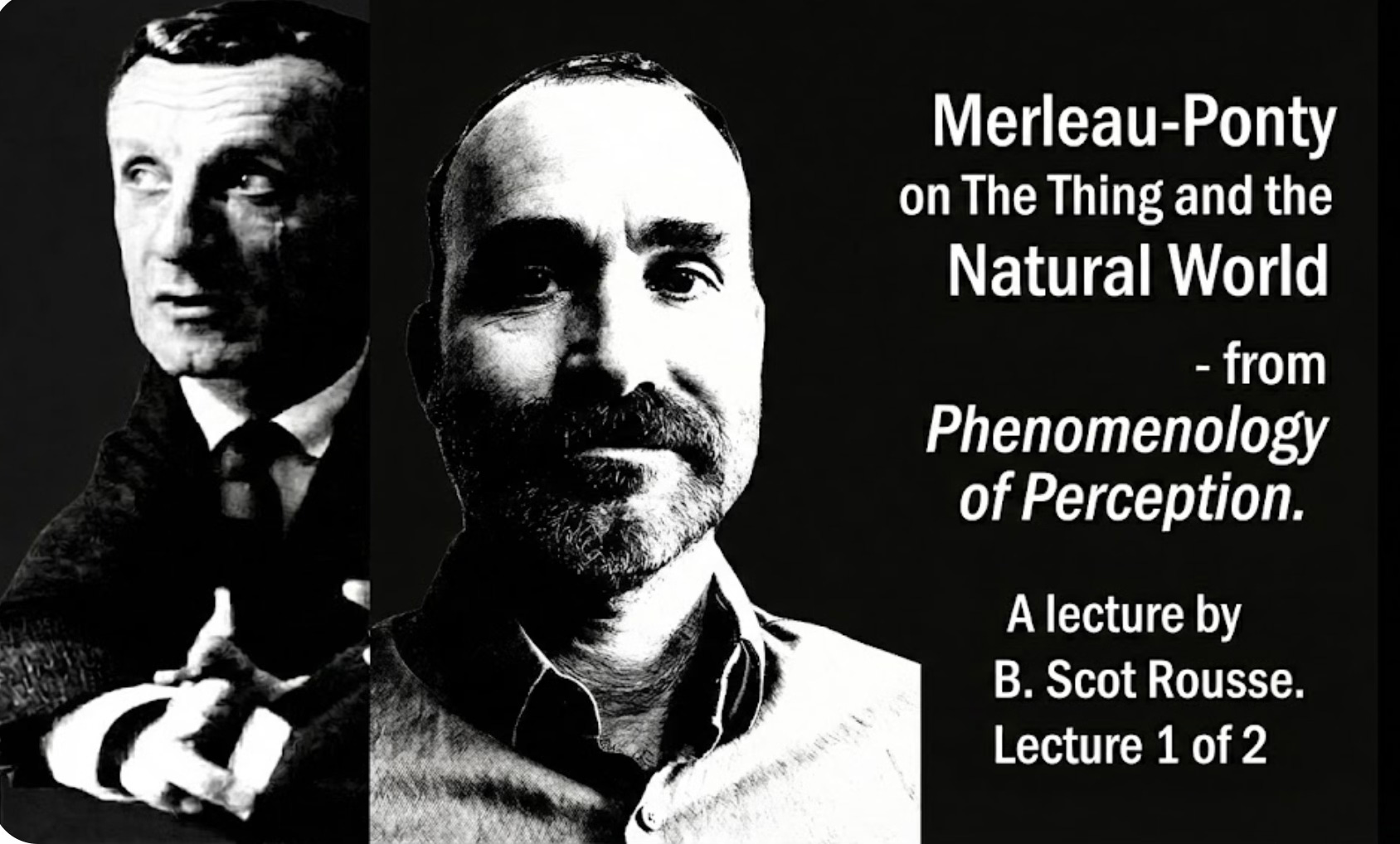
I uploaded two guest lectures I gave to Professor Alva Noë’s course on Merleau-Ponty’s Phenomenology of Perception. This was back in 2021, in the masked-up days of the Covid pandemic.
The reason I dug up these recordings is that I’m sitting in on a graduate seminar this semester that Professor Noë is teaching on the notion of The World. He’s teaching a few sessions on Merleau-Ponty, including the two chapters of Phenomenology of Perception that are explicitly focused on dimensions of worldhood: “The Thing and the Natural World” and “Other Selves and the Human World.”
I gave two lectures on “The Thing and the Natural World” in that 2021 class, and I wanted to revisit what I said then. It then occurred to me that other people might find the lectures useful.
“The Thing and the Natural World” is the most difficult chapter in the whole Phenomenology of Perception. For those with little or no experience with Merleau-Ponty, I’m not sure these lectures will be a very good introduction to this book or to Merleau-Ponty’s thought as a whole; but I try my best to bring out the exciting and radical ideas that Merleau-Ponty is exploring and to make the material relatable.
PS: If you are reading along in Merleau-Ponty’s text, you need to be using the 2012 Donald Landes translation; the previous translations are seriously compromised.
Despite how dense and difficult the chapter is to read, “The Thing and the Natural World” raises some of the most intriguing and original aspects of Merleau-Ponty’s version of phenomenology, and for this reason the lectures may be a useful initial overview of his early thought.
What would it mean to let a thing show itself before we rush to explain it? Before we slot it into categories, measure it, or treat it as a neutral object “out there”? In these lectures I aim to linger with Merleau-Ponty at precisely that overlooked, unstable experiential zone.
I try to bring into view Merleau-Ponty’s account of how the things we perceive show up within a dynamic field of lived, bodily engagement; his refusal of the classical split between subject and object in favor of a more primordial intertwining of perceiver and perceived; and his insistence that perception is not an inner representation of an external world but a direct, embodied access to a meaningful environment.
I also emphasize his idea that the world is not a collection of neutral facts awaiting cognitive capture, but a structured horizon that already solicits us, already bears significance, already exceeds any single perspective we take up on it, inviting us to explore, mingle, and merge with it.
The lectures focus on Merleau-Ponty’s attempt to radicalize phenomenology beyond a philosophy of consciousness and toward a philosophy of embodiment, involvement, and worldhood.
Even when the argument winds through intricate analyses of space, perspective, and the weird thinginess of things, they lead us to a profound reorientation: to get back in touch with ourselves not as detached spectators constructing the world from within, but as living bodies always already caught up in a world that we already inhabit.
If you watch the videos on YouTube, it helps me if you like the video and leave a comment.
Here is Lecture 1:
Lecture 1 explores:
The problem of the “thing” in modern philosophy: how the tradition turns things into objects with determinate properties, and what gets lost in that move.
Critique of empiricism and intellectualism: Merleau-Ponty’s rejection of both sense-data theories and pure conceptual construction.
The inadequacy of the subject–object split: why perception cannot be understood as an inner subject representing an outer world.
One’s “own body” (“corps propre”) as the condition of perception: embodiment as the site where world and perceiver intertwine. Bodies are not just further things we encounter. They are our vehicles of being in the world. They reveal the structure of the world to us. The structure of our perceptual world and the structure of our bodies are correlated.
The structure of perceptual fields: the body as the ground of our shifting perspectives, figure/ground relations, horizons, perspectival variations, and the way things exceed any given profile.
The thing as identity-in-difference: how a thing maintains unity across shifting perspectives without being reducible to a hidden “in-itself.”
Depth, space, and orientation: space as lived and inhabited rather than geometrically and analytically constructed.
The natural world as already meaningful: the world as a field of significance that solicits action prior to reflection.
The broader redefinition of phenomenology: moving from a philosophy of consciousness toward a philosophy of embodiment and worldhood.
Here is Lecture 2:
Lecture 2 deepens the argument by showing how perceptual constancy, normativity, and orientation arise from the body’s dynamic coupling with a structured yet inexhaustible world.
The main point of the second lecture is how Merleau-Ponty radicalizes Heidegger’s notion of being-in-the-world: extending Heidegger’s insight by bringing-forth the lived body as the site of the fundamental intertwining of organism and world.
This lecture explores:
“Maximum grip” revisited: perception as an ongoing bodily tendency toward equilibrium, poise, and optimal articulation, never fully achieved but always guiding experience.
The positive role of the indeterminate: background presence, non-sensorial yet operative, as a necessary condition for perceptual stability.
Color constancy and the articulation of the whole field: how perception depends on the structure of the entire perceptual situation, not isolated stimuli.
Lighting as background (éclairage vs. lumière): the distinction between light as object and lighting as a withdrawing, guiding condition that directs the gaze without becoming focal.
The body’s “setting of levels”: how our bodily situation establishes a background against which colors and qualities appear stable.
Intersensory unity: the refusal of neatly separated senses, and the claim that color, texture, sound, and weight interpenetrate in lived experience.
The thing as “a norm”: reality as that from which we can sense deviation, rather than as a fully graspable object.
Infinite exploration and the insurmountable plenitude of the real: the inexhaustibility of things as what secures their transcendence.
Beyond realism and idealism: the attempt to overcome the subject–object dichotomy by showing how things are both correlative to the body and at the same time irreducibly transcendent.
Body schema and world-correlation: the organism and its environment as co-defined, drawing on biological notions of Umwelt to explain how perception is neither projection nor passive reception.
Being-in-the-world radicalized: extending Heidegger’s insight by reintroducing the lived body as the site of this intertwining of organism and world.
I also have up my sleeve a lecture on the other Phenomenology of Perception chapter dealing with worldood: “Other Selves and the Human World.”
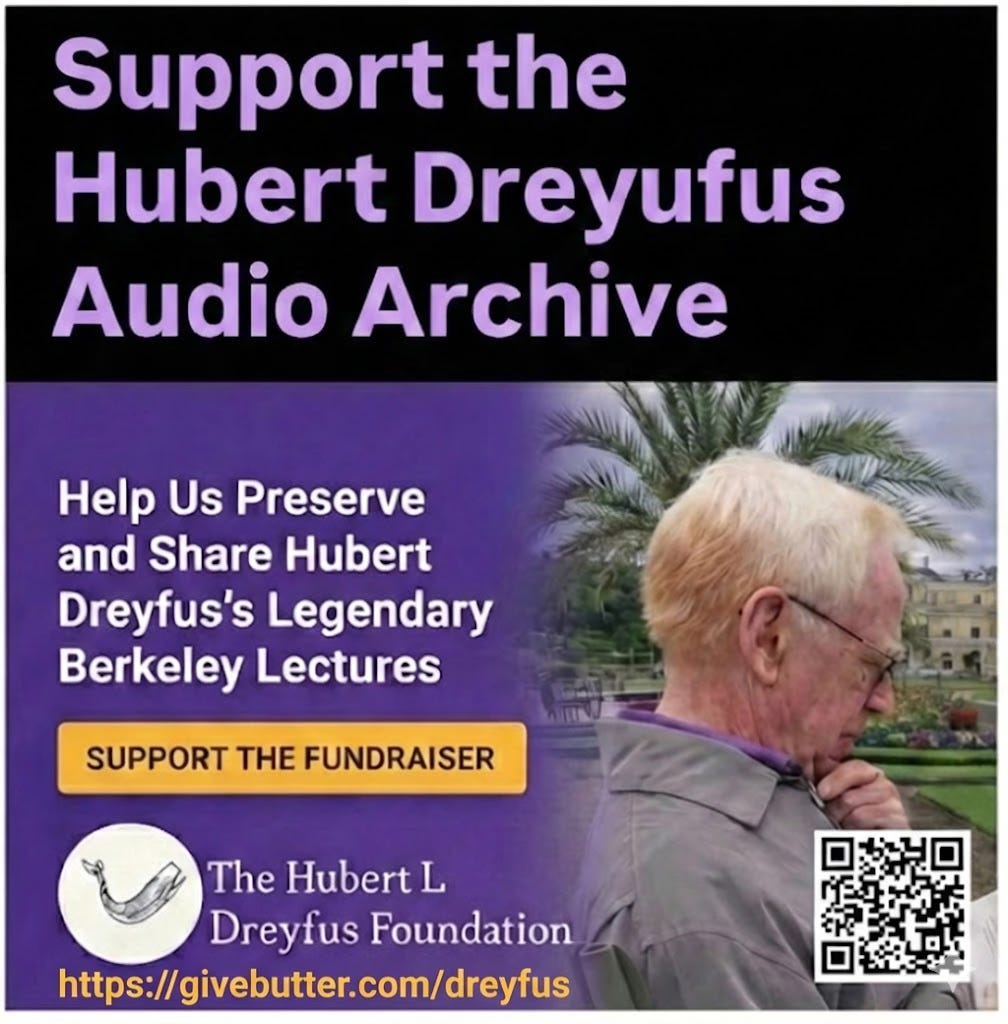
In 2013, I assisted Hubert Dreyfus in the last time he would teach his course on Phenomenology of Perception at Berkeley. In that course, I gave the lecture on “Other Selves and the Human World,” and I have an audio recording of it. If I determine that that one is worth sharing, I’ll be uploading it to my channel as well.
Speaking of Hubert Dreyfus, here is my reminder about the project to digitize and make available the thousands of philosophy lectures he left behind on cassette tapes. There are so many gems in the collection, I can’t wait to raise enough money to actually start the digitization and sharing process:
Excited to listen in to your lectures as time allows - I just finished phenomenology of perception a few months ago and have been working toward my dissertation which centers on the idea that we can use phenomenology, and Merleau-Ponty's phenomenology more specifically, to come up with pedagogical methods that combat some of our detached and abstract systems of learning. I think body schema is a fantastic way to think about identity development and personal growth as well as traumatic response in students, but I'm also interested to think through the idea of "maximum grip" and how teachers might create conditions (or, as my Heideggerian advisor likes to say - create clearings) for students' bodies to find that maximum grip. Ideally that creates some perceptual traction rather than just information processing... at least thats how I think of it.
Glad to have stumbled up on your substack!