
The Hubert Dreyfus Audio Archive Project
Philosophical Foundations for Living Well in the Age of AI

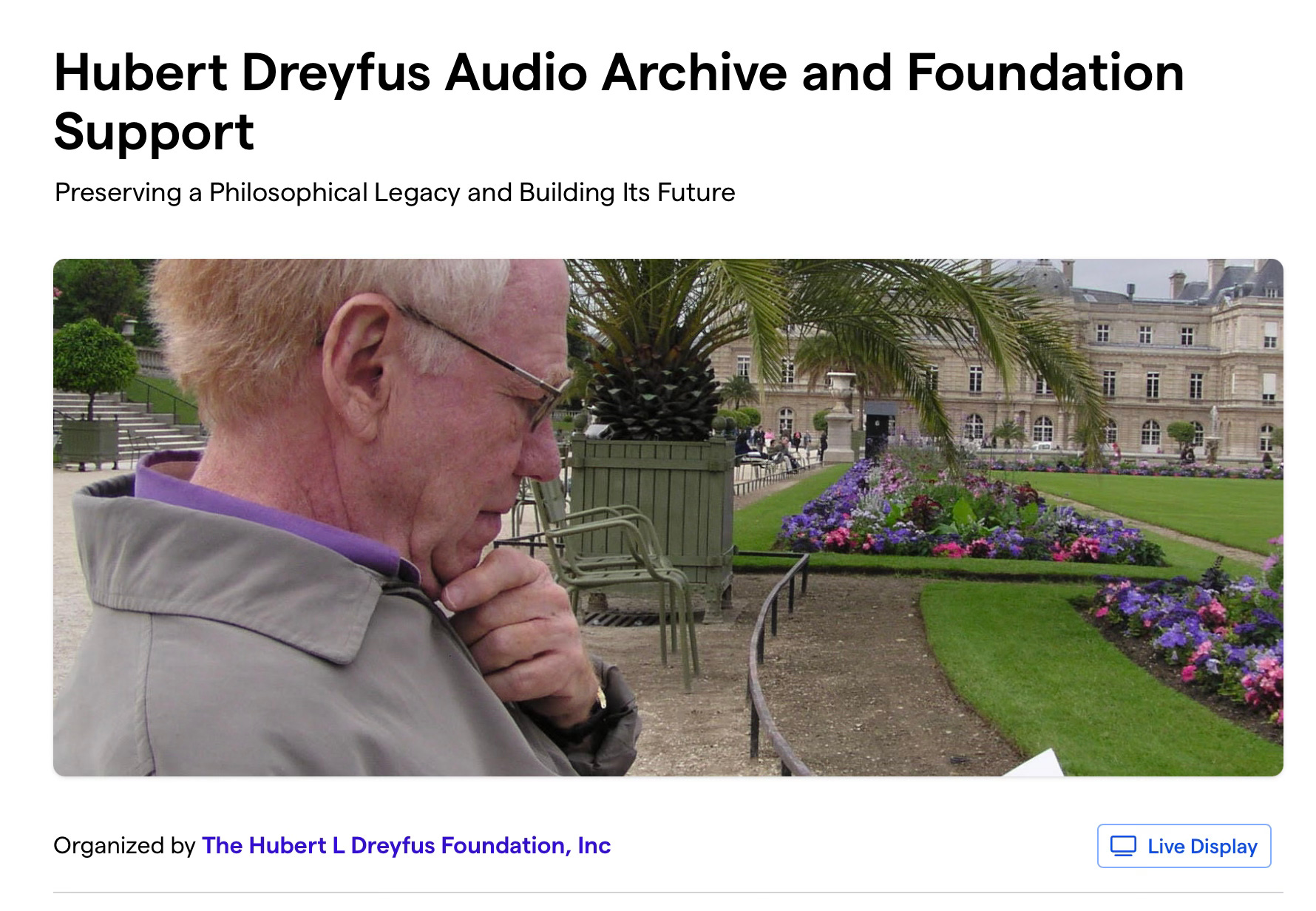
Today, I’m delighted to announce a new project I’ll be helping with at The Huber L Dreyfus Foundation, Inc. The HLD Foundation is a nonprofit, public benefit corporation founded by Hubert’s family after his death in 2017.
Here is the link to the fundraiser we have launched: https://givebutter.com/dreyfus
I’d be grateful if Without Why readers would share this link with others who might be interested in the project and in a position to support it financially. If you know of any grants or philanthropic organizations that could be a good fit, please let me know.
I will next share the text I prepared in collaboration with Hubert’s family to accompany the fundraiser. Then I provide a brief account of why this archive matters now, not only as an act of preservation, but as a resource for thinking about who we are becoming in our AI-shaped world
Supporting this project is a way of helping shape the philosophical foundations future students, researchers, and citizens will rely on when thinking about AI and human life.
SUMMARY
The Hubert Dreyfus Audio Archive Project is preserving and making publicly available an extraordinary collection of recorded philosophy lectures by one of the most important thinkers on technology, skill, and human meaning. At a time when AI systems are increasingly reshaping work, judgment, and our sense of what it means to act well, Dreyfus’s lectures offer rare resources for thinking clearly about what is at stake and how our technologies are also reshaping us. Supporting this project helps ensure that this philosophical inheritance remains accessible to students, researchers, and the broader public at a moment when it is urgently needed.
A massive trove of legendary lectures by philosopher Hubert L. Dreyfus is currently confined to aging cassette tapes in a closet in the Berkeley Hills.
With your support, we can build a professionally curated audio archive that preserves this irreplaceable material and makes it accessible to new generations of listeners. Dreyfus’s ideas and teachings are more timely than ever in our current age of AI.
The Hubert L Dreyfus Foundation, Inc. is a 501(c)(3) nonprofit organization committed to advancing the humanistic and existential values of philosophy in a rapidly changing technological world, and to preserving the legacy of Hubert L. Dreyfus’s distinctive approach to philosophical inquiry.
During nearly fifty years of teaching at Berkeley, from 1968 until his death in 2017, Dreyfus became a celebrated and often controversial voice in philosophy, especially for his prescient and ultimately vindicated critique of early AI. He was also a legendary teacher, always thinking aloud at the edge of his own understanding, drawing students into an adventure of shared inquiry. The surviving recordings bring listeners directly into that atmosphere: philosophy as a vital, searching, shared practice.
Dreyfus left behind an extraordinary archive: more than one hundred cassettes of lectures on Heidegger, Merleau-Ponty, existential philosophy, and beyond; seminars with figures such as Michel Foucault, Jürgen Habermas, and Charles Taylor; and rare recordings dating back to his 1964 presentation of “Alchemy and Artificial Intelligence” to the RAND Corporation, with obscenities uncensored! In the early 2000s, his lectures reached wide audiences through iTunes, as noted in the Los Angeles Times. When those lectures disappeared from iTunes, they survived only in dispersed, degraded, and often mislabeled copies spread across the internet.
We are raising funds to create a professionally curated, web-based audio archive of Professor Dreyfus’s lectures, restoring audio quality, organizing materials, and integrating syllabi and course documents that have never been publicly available. With your support, we can begin this work immediately and launch the archive by the end of 2026. As we approach the ninth anniversary of Hubert’s death, the moment is right to ensure that this long-envisioned project becomes a reality.
We seek to raise an initial $50,000 to establish the audio archive, secure the substantial print archive, and begin to lay the foundation for a durable institution dedicated to philosophical work in the spirit of Dreyfus.
If we raise $50,000 we can get to work on the audio archive. Ultimately, we seek to raise $500,000 to put the non-profit on a viable foundation for the next three years of activity.
At a time when AI systems increasingly shape how we relate to the world and to one another, Dreyfus’s work helps illuminate what remains essential in human life: embodied understanding, shared practices, and our capacity for care. Preserving his voice is a way of giving future generations the conceptual tools they will need to navigate the technological age we are entering.
Please help us make this audio archive a reality in 2026. All donations are tax-deductible.

Existential and Historical Context
As mentioned, one of the central projects of The Hubert L Dreyfus Foundation is preserving and making accessible the extensive archive of philosophy lectures Bert recorded, together with his substantial print archive.
Beyond his critique of AI, Dreyfus is was an influential interpreter of Martin Heidegger, Maurice Merleau-Ponty, and Søren Kierkegaard. He made the dense writings of these thinkers accessible and relevant to contemporary concerns in a remarkable way, focusing on themes of embodied skill, existential commitment, and shared practices of care. He was also a celebrated teacher, having taught at Berkeley for almost 50 years.
His lectures on these figures have taught generations of students not only from his classroom, but through unofficial, shoddy recordings that have circulated for decades on YouTube and file sharing sites.
A glance at the comments section on any of the videos of his lectures on YouTube reveal what an important difference his teachings have made for people all over the world.
To take one example of many, take the comments from this 2007 version of Dreyfus’s course on Heidegger’s Being and Time, viewed over 100,000 times. This recording was appeartanly ripped from iTunes, then posted on YouTube after iTunesU went down by a stranger with no connection to Dreyfus and no access to the syllabi and copious handouts he always generously provided his class.
It is time for The Hubert L Dreyfus Foundation to step in and make available to the public an official and professionally restored and curated audio archive of the timely philosophical resource that Hubert bequeathed to us in these recorded lectures.
Hubert was an electrifying teacher, and he was fastidious about recording his lectures. He recorded the lectures not only to make them available for students, but also for his own learning. He would routinely listen back to the sessions so he could ponder how he could explain things better, and also discern what he learned.
Anyone who listens to his lectures gets struck and inspired by how he approached teaching as an adventure of shared learning with his students. It gave his classes a distinctive mood of involvement, where understanding emerged through participation rather than instruction alone.
As mentioned above, the archive holds recordings dating back to the 1960s, including a 1964 meeting at the RAND Corporation where Hubert presented his notorious report on AI research for them, “Alchemy and Artificial Intelligence.” Hubert describes this meeting in the Introduction to the book he developed from this report, What Computers Can’t Do (1972):
[T]he year following the publication of my first investigation of work in artificial intelligence, the RAND Corporation held a meeting of experts in computer science to discuss, among other topics, my report. Only an ‘expurgated’ transcript of this meeting has been released to the public, but even there the tone of paranoia which pervaded the discussion is present on every page. My report is called ‘sinister’, ‘dishonest’, ‘hilariously funny’, and an ‘incredible misrepresentation of history” (p.86)
Adding to the intrigue that surrounds this recording for me is the news that it is sometimes rife with obscenities. Hubert’s wife, Geneviève Boissier Dreyfus, mentioned to me that, in this recording, “the obscenities are unblipped!”
Why Dreyfus’s Work Matters More Than Ever Today
At a moment when LLM-based AI systems increasingly shape how intelligence, language, and agency are understood (as a matter of disembodied algorithms operating over massive data structures), Dreyfus’s lecture archive helps sustain a way of thinking that treats those capacities as rooted in embodied practices, forms of care, and personal commitment.
AI systems are being woven into everyday life as participants in our communicative, cognitive, and institutional practices, shaping how work is organized, how judgment is exercised, and how language itself is understood. Questions Dreyfus pursued for decades about skill, embodiment, meaning, and the technological understanding of being have moved closer to the center of everyday experience.
Technologists dream of handing over more and more human work to machines. With tasks that once defined human work and expertise increasingly falling to AI, a simmering and underexamined disquiet begins to gnaw at us: the erosion of shared frameworks for human meaning, judgment, and purposeful engagement.
This shift raises concerns that go well beyond job displacement. UC Berkeley’s Stuart Russell, in his book Human Compatible, articulates it as “the problem of human enfeeblement”: the risk that, as machines assume more cognitive and productive labor, people lose opportunities to pursue meaningful projects, sustain skilled practices, and find orientation in shared forms of life.
For much of modern history, work has been a primary site through which people developed expertise, social identity, responsibility, and a sense of what it means to do something well. When machines increasingly perform that work, these sources of meaning are no longer reliably available.
This problem affects students, workers, technologists, and the broader public who are trying to understand how to live well in a world where traditional forms of work are being transformed or diminished. It also affects researchers and policymakers grappling with AI governance, who often lack conceptual tools for thinking beyond productivity, efficiency, or substitution when evaluating AI’s impact on human life.
Thus, Hubert Dreyfus’s lectures and teachings constitute an invaluable resource for anticipating and preparing for this future. Dreyfus lectures explore how human meaning is generated through skilled, embodied involvement in practices that gather and matter to us. We need these conversations now more than ever.
The Hubert L Dreyfus Foundation’s Three-Year Plan
Our fundraising campaign will support a focused three-year plan to transform Hubert L. Dreyfus’s archival legacy into a living intellectual resource.
In year one, our primary goal is the creation and launch of the professionally curated, web-based audio archive. This work includes digitization, audio restoration, careful cataloging, and the integration of syllabi and course materials. During year one we will also relocate Dreyfus’s voluminous print archive in a secure location and begin digitizing key elements. We will embed the recordings with a light layer of scholarly context: dates, course information, key themes, and brief guides to the debates Dreyfus was intervening in, and their current relevance. At the end of year one, we aspire to convene a conference bringing together scholars working in fields shaped by Dreyfus’s thought, marking the public debut of the archive and the renewed work of the Foundation.
In year two, we will expand the Foundation’s public presence. We will launch a podcast drawing on the lecture archive and featuring new conversations with philosophers carrying forward Dreyfus’s intellectual tradition. We will establish a regular lecture series, both online and in person in Berkeley, and inaugurate an annual prize for the best paper in areas of philosophy central to Dreyfus’s work.
In year three, we will deepen the Foundation’s support for emerging scholars. We plan to establish fellowships and scholarship support for students, continue the lecture series and podcast, and begin editing selected lecture courses for publication. Together, these efforts will ensure that Dreyfus’s work remains not only preserved, but actively engaged with by future generations.
I remember attending an event near Columbia University announcing this initiative several years ago. I’m surprised it is not completed by now. Happy to donate what I can. In the meantime how can we access the lectures?
Our students are already finding their way to (and loving) Dreyfus' available lectures and we should absolutely put in the work to make a polished, curated version of the rest of his lectures available, too.