
Strange Familiarity: Heidegger on Skill
The Philosophical Significance of Familiarity


Background and Set Up
Without Why has been on Substack now for one year! My first post here was July 4, 2025. I had done about 6 months of writing on a previous platform but never got much traction.
Many of those early posts have been seen by virtually no one so I plan to reshare some of them. The one I’m sharing below, “Strange Familiarity: Heidegger on Skill” helps me set up another I will share next week, one focused on the Dreyfus Skill Model. They are particularly relevant because they help, in turn, to set up a new major publication of mine.
A peer-reviewed research paper called The Fate of Expertise in the Age of AI (co-authored with my friend and colleague Massimo Scapini of Anchorsite AI) will appear any day now, in the summer issue of Journal of Expertise.
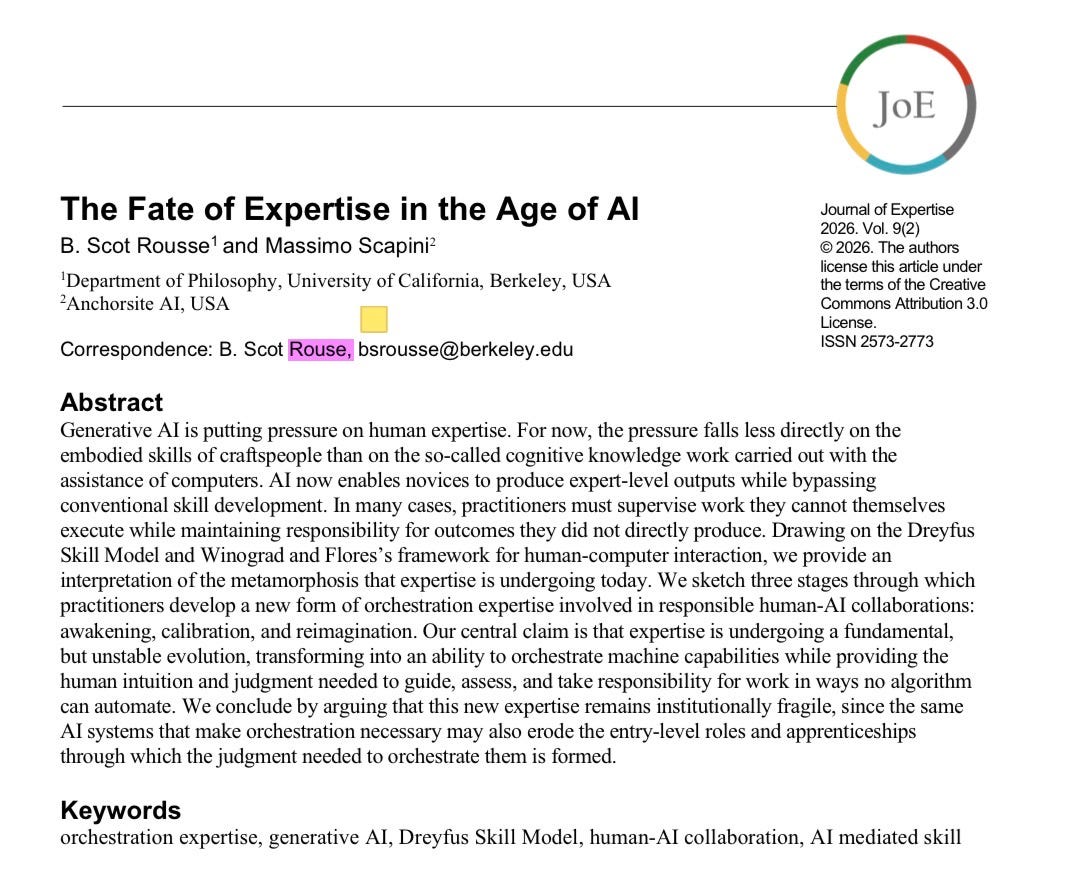
(I will write more about the above pictured research when the paper appears.)
Beyond this, I’m celebrating that as my first year on Substack ends I’m now up to 900 subscribers, with 82 paying. Thank you! I could not do this without your support!
Some of my favorite recent pieces are:
Machine Consciousness and Moral Vertigo (including my slides from a recent talk of this title. I had a lot of fun making these slides! The visual motif comes from Alfred Hitchcock’s Vertigo)
An Exploration of Artificial Self-consciousness (including my slides from a recent talk of this title. I had a lot of fun making these slides! The visual motif comes from the 1973 surrealist French animation, La Planète Sauvage)
Can AI Help Us Become Who We Are? (a response to this post by Houda Nait El Barj)
AI, Pinocchio, and the Evolution of Conscience (one of my favorite pieces, notable for me for how it dispenses with typical scholarly exposition for a more narrative-forward approach)
Punk, Tech, and Care: My Conversation with Andrea Hiott (a link to an awesome podcast by Love and Philosophy and Andrea Hiott that I was honored to be featured on)
“A full and enviable philosophical life: Remembering Hubert Dreyfus” (a remembrance of my PhD advisor and dear friend Bert who died 9 years ago)
Clarifications of Care (a response to a reader’s comment. I’ve been developing a whole body of work focused on care and its relevance for living well in the age of AI. See here for the whole list. I have several more contributions to this project forthcoming.)
One of my main goals for Without Why is the enrich philosophical resources and foundations for orienting ourselves in the age of AI.
During my first several months, I wrote several brief posts about the philosophy of Martin Heidegger, attempting in plain English how his thinking illuminates basic issues in human agency.
Initially I had intended to write a section-by-section commentary on Being and Time, convinced as I am that Heidegger’s thought there provides good resources for understanding how technology shapes human life, and how to live a meaningful human life in the midst of uncertainty and historical change.
I put that project on hold because I ended up focusing all of my Heidegger energies on teaching Being and Time at UC Berkeley last summer. So, instead of doing a section by section textual commentary, I will soon starting sharing videos of my lectures on Heidegger, where I also strive to explain his difficult but worthwhile text in plain English with relatable examples.
What follows below is one of my entries on Heidegger, this one focused on introducing Heidegger’s understanding of the philosophical significance of skill. I will share further of my Heidegger posts in coming weeks.

Strange Familiarity
In our everyday lives, we operate with an underlying sense or understanding of being.
This understanding lets us distinguish and interact with various entities—ourselves, other people, fictional characters, bicycles, trees, and cats—without needing a formal theory of being.
Our sense of being is like the familiarity we can have with our hometown, even if we can’t draw a map or give precise directions for getting around in it.
Rather than being theoretical knowledge of definitions, our sense of being is more like a “know-how” or sense of familiarity.
Heidegger unfolds his revolutionary philosophical project by carefully describing everyday familiar situations. These were the kinds of situations and experiences previous philosophers did not bother to notice.
Consider the situation of making breakfast in your home kitchen. Here you have a range of typical tools and skills: toaster, bread, refrigerator, coffee maker, knives, forks, plates, and so on. Once you have your breakfast-making routine down, you can bumble bleary-eyed around in the kitchen while making breakfast half-asleep, or with your mind on the important tasks of the day ahead.
In an unfamiliar kitchen our breakfast-making skills get thwarted. Then we need to ask where to find things and we need guidance on how to use unfamiliar appliances and ingredients.
Heidegger unpacks the flowing-familiarity we have with our own kitchen in terms of an innovative ontological category: “readiness-to-hand” (or “availableness,” both attempt to translate Heidegger’s term Zuhandenheit).
I won’t stop to discuss this term now, except to emphasize that something is ready-to-hand in this special sense if we can use it skillfully, without having to think about it.
Heidegger’s guiding intuition is that the world (and, indeed, being) reveals itself distinctively through our familiarity with what is ready-to-hand. Before Heidegger, philosophers focused on how the world appears in detached, theoretical reflection, not in skillful engagement.
Traditional philosophers before Heidegger related to the world like it was a strangely unfamiliar kitchen.
For Heidegger, this detached view reveals the world not as “ready-to-hand” but as an “occurrent” thing for observation and measurement. Heidegger calls this mode of being “presence-at-hand” (or “occurrentness,” both attempt to translate Heidegger’s term Vorhandenheit).
Ultimately, Heidegger will argue that this detached, observer’s perspective is unable to make sense of the world and our place in it. Our relationship to the world is first of all one of familiarity and skillful involvement, not detached, theoretical knowledge.
“Here you have a range of typical tools and skills: toaster, bread, refrigerator, coffee maker, knives, forks, plates, and so on. Once you have your breakfast-making routine down, you can bumble bleary-eyed around in the kitchen while making breakfast half-asleep, or with your mind on the important tasks of the day ahead.”
This is also Merleau-Ponty’s body schema in the way he talks about then incorporation of tools (he talks about the blind man with the cane, for example, and how the cane becomes an extension of his embodied being.) When tools become so incorporated they give us unfettered access to that world - the ‘breakfast making’ world… it’s just a part of our being.
My advisor is a Heidegger scholar and my focus has been on Merleau-Ponty and I really enjoy how much M-P pulls from Heidegger even if he refuses to admit it or cite it. It’s an interesting relationship to me.