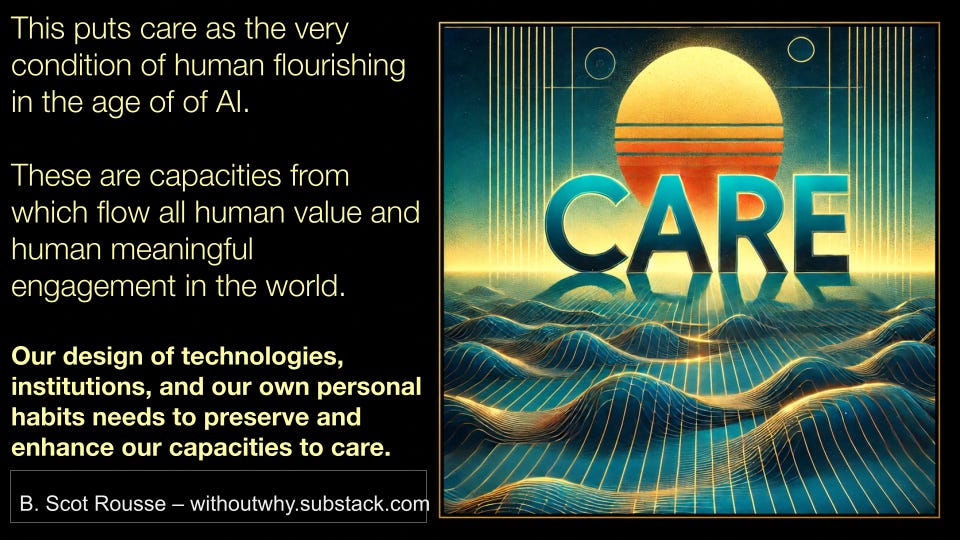
Care, Human Enfeeblement, and the Existential Implications of AGI.
My mini-manifesto on care (video and essay)
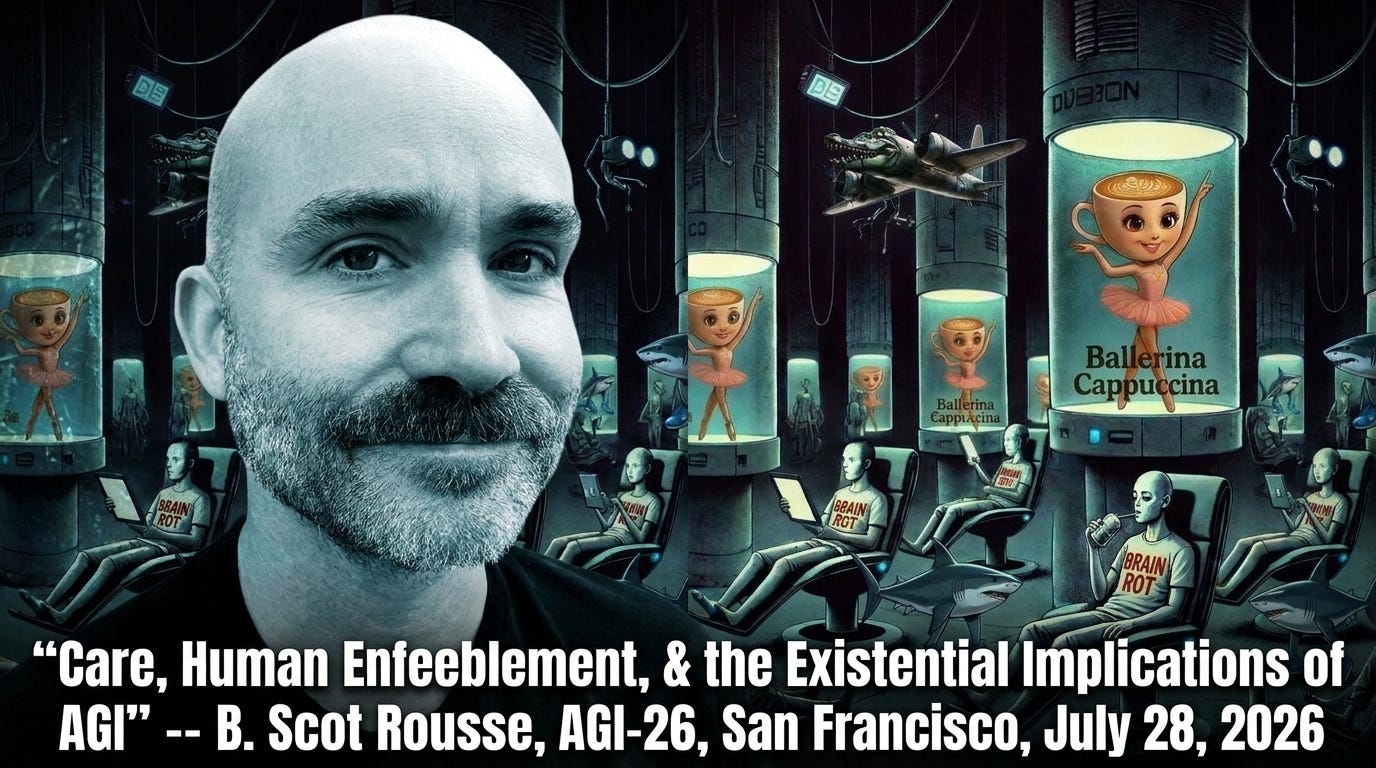
Inspiring Times at AGI-26
I had an inspiring time giving two talks at the AGI-26 conference in San Francisco last week. Today I’m sharing the video and extended text of my talk in the main program. I also gave a more technical philosophy paper on the workshop day in the “consciousness track.” I will share and discuss that one in a near-future post.
My talk in the main program is called “Care, Human Enfeeblement, and the Existential Implications of AGI.” This is also the title of the position paper that forms the basis of this talk.
When I use the term “existential” here, I’m not talking about the risk of extinction to the human species. Rather, I’m talking about the risk of the extinction of meaning in human life.
This talk and paper sketch my framework for how to answer a question I've deeply absorbed myself into over the last year: What becomes of human meaning and purpose in a world rushing to deliver more and more of our activities to machines?
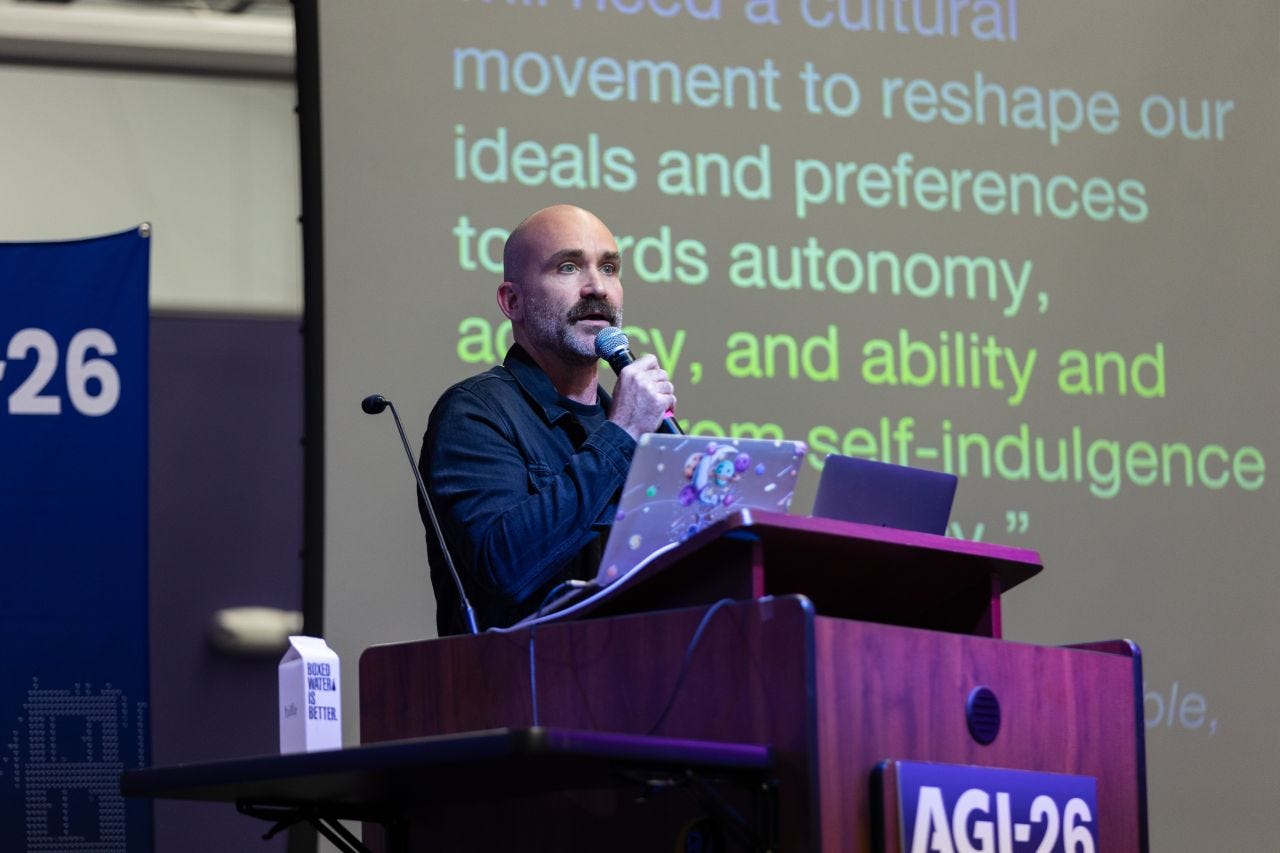
Drawing upon traditions such as phenomenology, nursing, developmental psychology, feminism, and human-computer interaction, I approach this question through an interpretation of care and its role in human life. I've come to think of my AGI-26 talk (and its accompanying position paper) as my "care manifesto" for living meaningfully in our AI age.
In this work, I’m building upon scores of conversations and collaborations I currently have or have had with a variety of thinkers and researchers, such as Patricia Benner, Peter Denning, Stuart Dreyfus, Fernando Flores, Julian Jonker, Ivar Kolvoort, Massimo Scapini, Marjan Sharifi, David Spivak, Terry Winograd, and Alex Zhu.
The talk definitely struck a chord with the AGI-26 audience, and it was immensely gratifying to have so many conference attendees and speakers take me aside to share their enthusiastic reception of what I presented.
Just below is a recording of my presentation, along with the q&a session where I fielded two audience questions. Below this, I also share a link where you can download the position paper.
Here is the video:
The talk is drawn from a brief 6-page position paper which has been published in the conference proceedings.
You can download a pdf of my short care manifesto by clicking the following link: “Care, Human, Enfeeblement, and the Existential Implications of AGI.”
You can also download here the pdf of the entire volume in which my paper appears.
Also, here is the video of the whole first day of the conference. My talk starts at the 4:37:38 mark.
I am grateful for the comments of three anonymous reviewers for the AGI-26 conference who offered helpful feedback and suggestions for improving the paper.
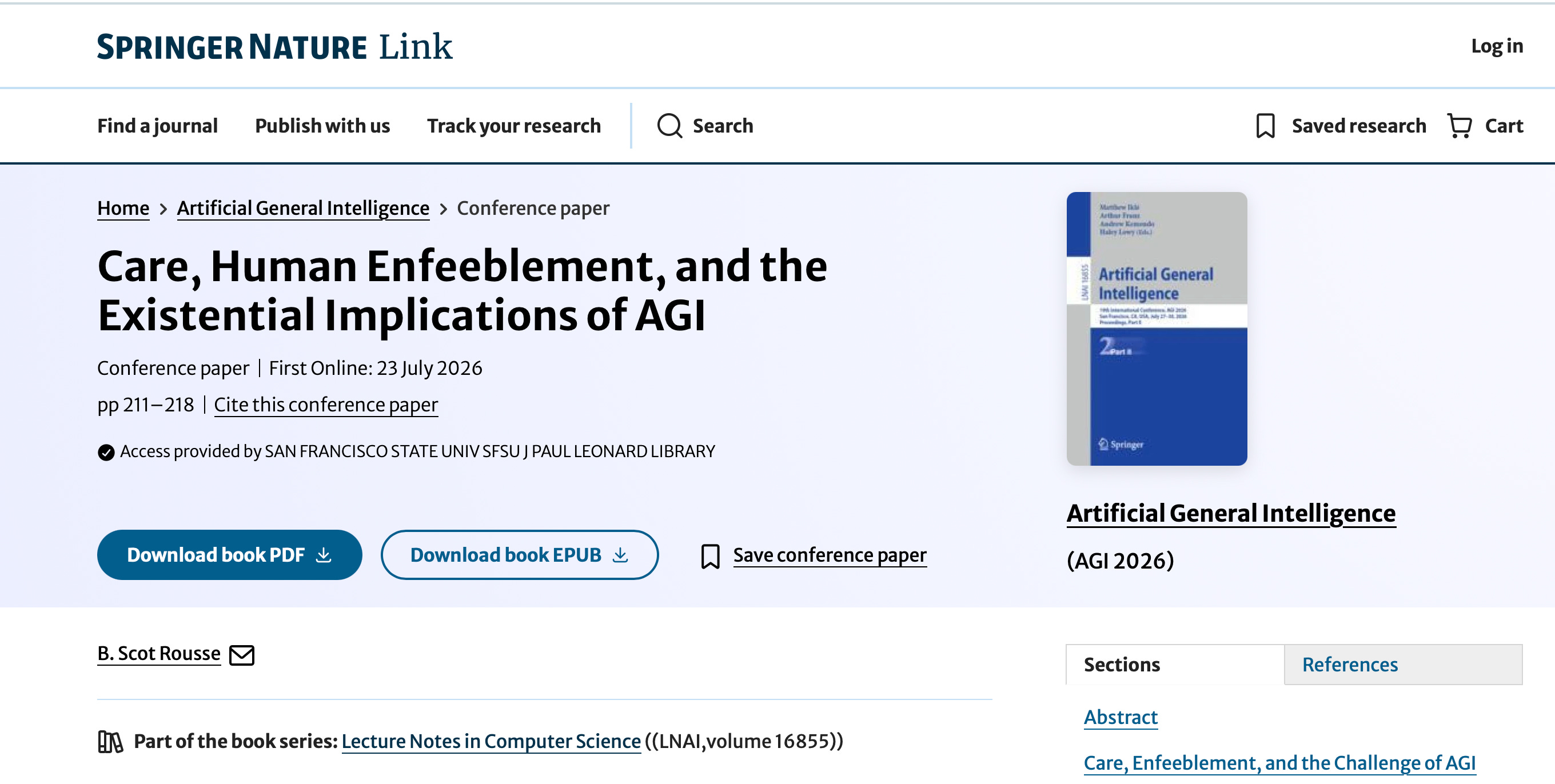
This talk and paper argue that care isn’t a feeling — it’s a skill, or really a constellation of interrelated skills, enabling us to be meaningfully engaged in the world and with each other:
The ability to be struck by what matters (rather than being locked in problem-solving or optimal-delivery-mode), to focus and share what matters in language, to take stand to take care of it despite uncertainty, and to coordinate action and understanding with others so that our commitments become real.
AI systems built to cater to our whim, pre-select for us a menu of options, immediately solve our problems, or offer frictionless friendships and relationships risk wearing those skills away.
One cheeky way to put my punchline is this: the shift we need is from catering to caring — designing AI that supports strengthens these capacities of care through we co-generate our worlds and realize what matters to us. These are the capacities that make human lives worth living and worlds worth inhabiting.
Please read the paper or listen to the talk (or both!) for some illustrations of this. As the thesis is put here, it floats at a pretty high level of generality.